



Questions about legacy trade agreements are not high on every Scottish independence supporter’s agenda. One that does need to be answered to avoid walking blindfold into trouble is: will Scotland inherit UK trade and investment agreements that allow overseas investors to sue the government for changing domestic policy to protect the environment, the workforce, or public interest? Whether the answer is yes or no, the risk is one to be aware of.
The right to sue is granted by Investor-State Dispute Settlement (ISDS) clauses in Free Trade Agreements (FTAs) and Bilateral Investment Treaties (BITs). ISDS clauses allow investors to take legal action against governments for alleged breaches of investment protection. Disputes are heard by an international tribunal named in the agreement or treaty and set up by The World Bank, International Chamber of Commerce, United Nations (UN), or other global organization. Decisions are legally binding with no right of appeal.
Awareness of ISDS is low*, even in the commercial sector, yet their impact can be as constraining as colonial government. Two recent publications expose the damage they can inflict. A popular political blog calls ISDS a kind of terrorism. A book by two investigative journalists describes a system designed to de-risk capitalism and ensure that nations do not control their own resources.
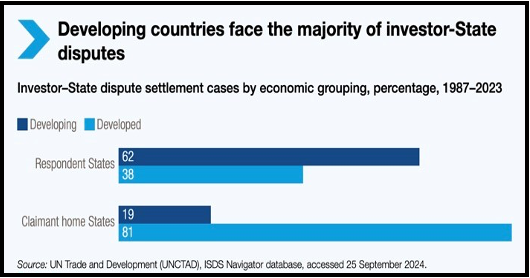
In December 2024, the UK was party to 39 FTAs and 83 BITs with 90 of these agreements using ISDS clauses. (Incidentally, it is also the home state of 115 claimants in ISDS disputes). Whether or not our government was consulted before signing, Scotland is bound by these agreements as long as it remains in the union. The question is, will they persist after independence? Possibly not, if the UK’s departure from the European Union (EU) can serve as an example. But that does not mean it is in Scotland’s interests to ignore them, or that the matter will be easily resolved.
What are ISDS?
ISDS were introduced in the 1950s and 60s, mainly to protect international investor interests in post-colonial and developing economies. A proliferation of disputes in the 1970s–1990s exposed ISDS as a rogue offspring of gunboat diplomacy that infiltrates global trade agreements giving corporate interests the right to sue governments for any action resulting in lower-than-expected returns. In some cases, corporate interests can overrule national sovereignty. Grounds for investor claims under ISDS are broad and open to interpretation. Clauses are specified in each agreement, with four common grounds for claims.
- Expropriation of assets: disputes arise if a government nationalizes or takes control of an investor’s assets without ‘adequate compensation’. Oil and gas are high risk industries with corporate giants like BP (UK), Shell (UK-Netherlands), Total Energies (France), Equinor (Norway), and U.S. funds invested in energy infrastructure. These giants have deep pockets and some have no qualms about using devious means. Investors in Scotland’s renewable energy sector are equally formidable; China General Nuclear Power Corporation (CGN), Chinese state-owned SDIC Power Holdings, and others, like DEME, Qair, and Aspiravi, that give no clue to owners’ identity.
- Unfair treatment: this allows claims of discrimination against overseas investors, for example, by offering favourable terms to protect domestic industries.
- Breach of legitimate expectations: this applies if governments change domestic regulations in a way that undermines an investor’s expected returns, e.g. by banning fossil fuel extraction or tobacco advertising, raising minimum wages, applying pollution controls, removing tax breaks, or imposing tariffs on environmentally harmful exports.
- Denial of justice: cases arise where an overseas investor believes they cannot access fair legal process within the host country. For example, India may be at risk of claims for requiring appeal to domestic courts for five years before cases can be taken to an international tribunal.
These broadly stated grounds for dispute impact many areas of government policy, yet they are open to interpretation by global tribunals with no remit to consider matters of national interest.
ISDS reform
The EU, India, Australia, Brazil, South Africa, Ecuador, Indonesia, Bolivia and, to some extent, the UK, are renegotiating or replacing traditional ISDS clauses with alternative protective measures that do not favour investors over government policy and public interest. The UN Conference on Trade and Development (UNCTAD) report on this trend and common concerns driving the change.
- Sovereignty: traditional ISDS clauses allow corporations to override national laws and policies, limiting government ability to act in the public interest.
- Transparency: ISDS cases are heard behind closed doors in commercial courts in distant countries, raising questions about process, fairness, and accountability.
- Bias: investors can sue states, but states cannot sue investors.
- Inconsistency: different tribunals have made conflicting decisions in similar cases.
- Cost: legal fees to defend a case can run to millions of dollars.
- Inhibition: governments may be reluctant to introduce new regulations in key areas, such as environmental and employment protection or public health, for fear of being sued.
Perusing a list of 1,404 registered disputes and a summary of risks and mitigation strategies begs the question: do governments read the small print before signing up to ISDS clauses?
After independence
The good news is that Scotland, as a newly independent nation, should cease to be bound by agreements made as part of the UK. Whatever the agenda was a year before the 2014 independence referendum, the UK government commissioned and publicly approved a legal opinion that identified England as the ‘continuing state’ to be bound by existing agreements. Scotland would be a ‘successor state’ free to negotiate new deals in the same way as the UK, a successor state after Brexit, ceased to be bound by EU agreements. An expert review of this briefing paper by an EU trade advisor endorsed this as the most likely scenario.
However, with the validity of the Acts and Treaty of Union and the voluntary nature of a union from which there is no clear exit route now being challenged, this outcome cannot be seen as a given. It is just one of three options outlined in a briefing paper written by House of Commons researchers back in 2011.
Two alternatives were separation where both, and dissolution where neither party would be bound by existing agreements. These options were not framed as legal or professional advice and the situation has changed dramatically since 2011, so the real case needs to be tested. A lack of clear precedent and unusual circumstances have led to many opinions on the subject, with an equally broad range of vested interests moving to protect their own. The bottom line is that independence by any route requires negotiation and reference to principles of international law. Awareness and forward planning will allow Scotland to set the agenda and lead that conversation.
Trade and investment agreements will be an early priority post–independence with interim measures to cover the transition. A relatively simple option would be to honour existing agreements for a set period as the UK did after leaving the EU. Avoiding disputes with global investors and protecting national sovereignty would be guiding aims for negotiators.
There are enough examples to learn from as various countries move to reduce the risk of being sued in remote investment tribunals. Scotland would be wise to terminate or renegotiate existing agreements before introducing new laws, moving to nationalize any major industries or acquire foreign-owned assets. Options are to withdraw from ISDS, (e.g. Ecuador, Bolivia); use an Investment Court System (ICS), (e.g. EU, Canada); require state-to-state arbitration, (e.g. Brazil, India); use public interest exemptions and bring dispute settlement back to domestic courts, (e.g. India, Indonesia, South Africa). Phasing regulatory changes in gradually can also help to avoid costly legal challenges.
Scotland in transition
A well-planned and managed transition will keep critical systems running until new arrangements can take over. Again, there are international examples to adapt or follow.
- Honour existing UK trade/investment treaties for a set period of time.
- Offer existing investors protection within a fixed timeframe to ensure stability but with no long-term commitment.
- Introduce public interest clauses in all new agreements.
- Use stabilization clauses to ensure continuity in high stakes industries.
- Negotiate on World Trade Organization (WTO) transition arrangements.
- Seek UK economic zone participation in sectors where this is feasible.
All trade and investment agreements have an expiry date and withdrawal or termination clauses. Some agreements include periodic reviews. A major shift like becoming independent would open a rare window of opportunity for Scotland to take back control–if not necessarily ownership–of national assets and to establish direct working relationships with trading partners and unions. Doing so on good terms with global investors will require a sharp focus in strategic planning and skillful negotiation.
A note on freeports and SEZs
Freeports and Special Economic Zones (SEZs) add a layer of complexity to the situation. These areas are designed to attract investors by granting exemptions from domestic law and regulations in areas such as employment, the environment, ownership, taxes, and tariffs. Any changes to the terms offered when a business set up in a Freeport or SEZ put the host state at risk of being sued by profit motivated investors. Governments can be reluctant to change domestic policy because of the cost of defending an international lawsuit arising from such arrangements.
Two areas in Scotland, Inverness and Cromarty Firth and Forth Green Freeports, were set up with Scottish Government approval so the status and rights of overseas investors after independence need to be reviewed. A legal opinion on the intersection of Freeport and SEZ status with domestic policy will also be required. If the same rule applies, that agreements are not inherited by a party that leaves a union, that would be to Scotland’s advantage. Investors may take a different view.
Scotland’s future
Investor caution about a newly independent nation is to be expected, even if Scotland has its own central bank, currency and trade institutions in place on day one. Strategies based on international experience may boost confidence and ensure sovereignty remains with the state, for example:
- Limit ISDS exposure by adopting state-to-state arbitration for disputes. This would impact corporate lawsuits that challenge domestic regulations (e.g. environmental policies) and keep dispute resolution transparent.
- Offer sector-specific protections linked to performance-based incentives, e.g. green energy or job creation, instead of blanket ISDS.
- Create a specialist commercial court for investment disputes or align with the EU Investment Court System. This is more transparent with an appeal mechanism and publicly appointed judges rather than remote corporate arbitrators with potential for conflicts of interest.
- Negotiate tariff schedules and market access terms with the WTO. Consider using phased tariff reductions and maintaining temporary import restrictions to protect domestic industries.
- Exclude certain policy areas from investment protections to safeguard Scotland’s ability to regulate key areas such as health, environment, and labour law without investor retaliation.
- Avoid signing up to the Energy Charter Treaty which allows oil companies to sue over lost profits and is in direct conflict with national aims to transition to net-zero emissions. The UK gave notice in 2024 and various European countries have, or plan to, exit this agreement.
Independence could add a convenient ISDS escape clause to the prize of self-determination. Current campaigns suggest Scotland has all the right expertise to navigate the transition and set favourable terms of trade with the rest of the world if/when that window of opportunity opens. The ability to bypass party politics to apply that expertise to the task may be the biggest remaining hurdle.
*Author’s personal observation.
More on economics.


Your voice, your story – independent powerful citizen journalism.
Consider supporting us monthly
A newspaper costs approximately £60.00/year, you can enjoy Bylines Scotland for £36.00/year – please think about supporting independent citizen journalism




