



A new discussion paper by Dr Dirk Ehnts and William Thomson finds that if an independent Scotland follows the European Union’s Stability and Growth Pact (SGP), as proposed by the current administration, the result would be years of spending cuts and a serious weakening of economic resilience.
The paper stresses that these outcomes are not inevitable consequences of independence itself, but arise specifically from the political decision to align Scotland with the EU’s SGP rules. The paper questions the current Scottish government administration’s economic plan for independence.
The authors emphasise that other economic frameworks are available that would allow an independent Scotland to prosper, maintain resilience, stability, and have the capacity to respond effectively to shocks.
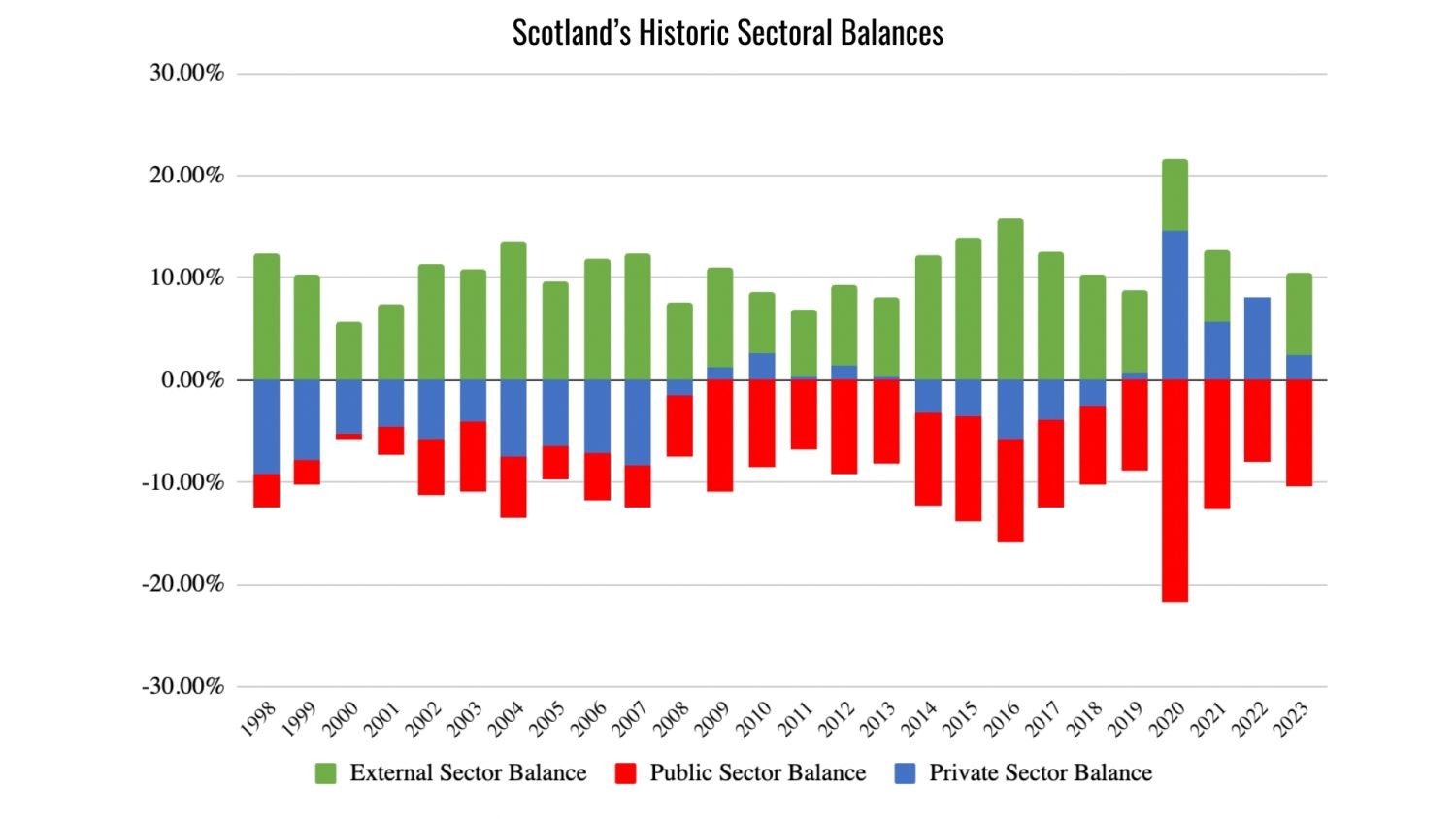
Drawing on “Scotland’s Sectoral Balances” – introduced for the first time in the paper – shows Scotland’s public deficit would naturally stabilise around 12% of GDP under plausible conditions (with the private sector saving approximately 5% and the foreign sector in surplus approximately 7%).
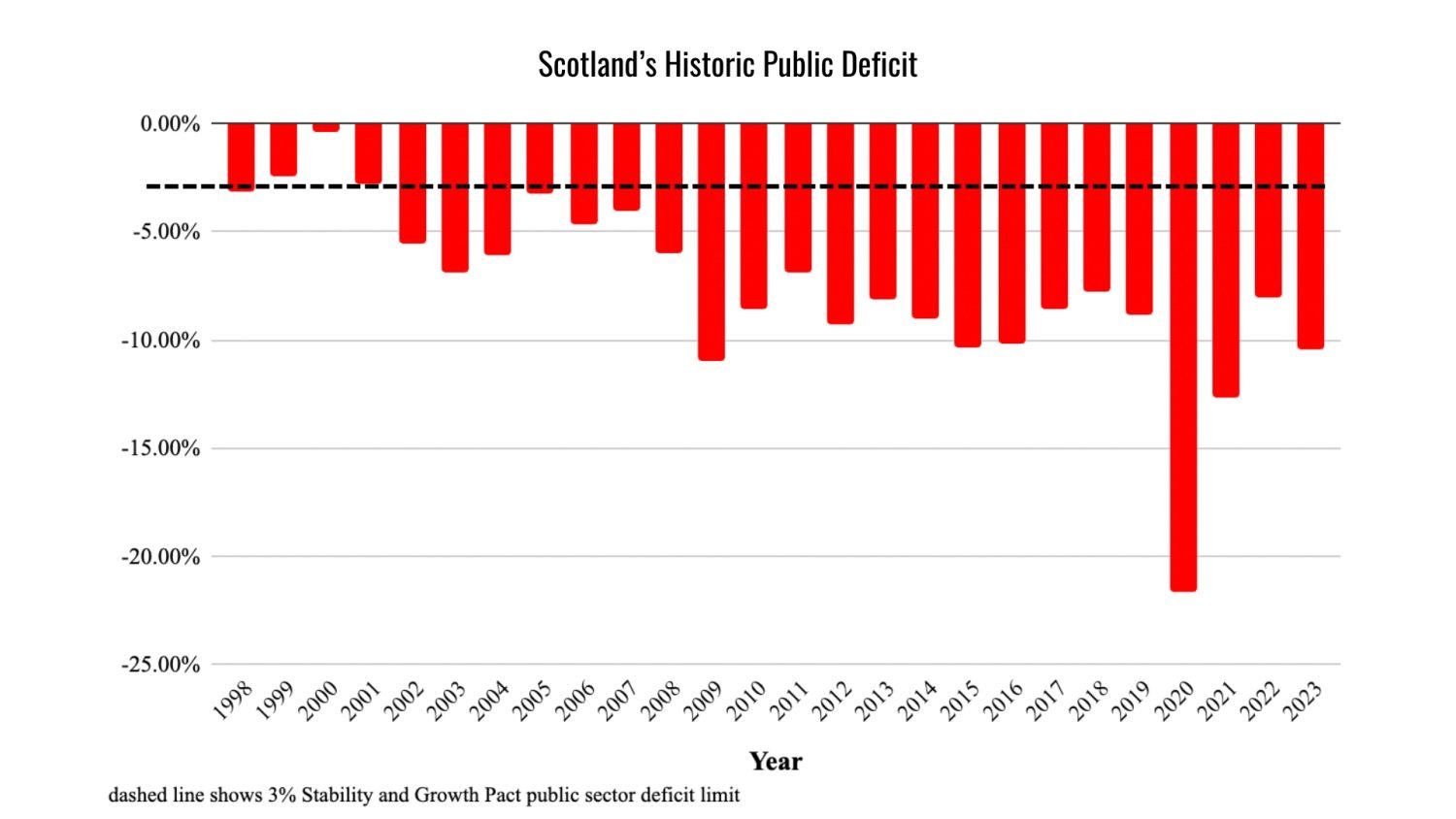
Forcing the deficit down to the SGP’s 3% cap implies years of cuts that undermine resilience by weakening automatic stabilisers and limiting the government’s ability to support households and businesses.
William Thomson, co-author, said:
Following the Stability and Growth Pact leads to the government’s focus shifting from tackling society’s real needs to simply managing the fiscal deficit, a rather meaningless statistic.
Dr Dirk Ehnts, co-author, said:
The Stability and Growth Pact ensures that adjustment in the eurozone works through fiscal austerity. ‘Excessive’ deficits lead to cuts in government spending, which in turn reduce GDP, and subsequently consumption and imports. They also reduce tax revenues, which is why the idea of adjustment through austerity policy has never worked: countries ended up with public debt.
What are sectoral balances?
Sectoral balances track financial flows between three parts of the economy: the government sector (spending and taxation), the private sector (households and businesses saving or borrowing), and the foreign sector (trade and income with the rest of the world). By accounting identity, the three balances sum to zero: if the private and foreign sectors are in surplus, the government must be in deficit. Scotland’s large foreign sector surplus ensures a corresponding high government deficit. This lens helps explain why Scotland’s deficit is structurally above 3% and why forcing it lower would require austerity.
Key findings
Resilience risks for households and services. SGP compliance channels the adjustment through cuts to public services and support, raising unemployment and increasing household debt stress, with disproportionate effects on low earners, women, and children.
All paths to 3% imply sustained austerity. Even the most gradual route requires approximately 1.7% real-terms cuts each year for 15 years – roughly the level of austerity suffered during the UK’s ‘austerity years’ of 2010 to 2015. Faster paths demand 3.2%, 7.5%, or 12.5% annual cuts – judged politically unachievable.
Scotland’s starting point matters. Baseline sectoral balances suggest an approximately 12% public deficit alongside a approximately5% private surplus and approximately 7% foreign surplus under plausible conditions – not a configuration compatible with a 3% cap.
Income outflows amplify the external surplus. Since 1998, Scotland has averaged approximately £11.5bn net income outflow annually (profits, dividends, interest), swelling the foreign sector surplus and removing room for the government to drastically reduce deficit spending.
Recommendations
Do not pre-commit to SGP-style limits before EU membership; adopt Scotland-specific guide rails built around real-economy objectives (resilience, full employment, price stability, sustainable use of resources).
Publish and maintain Scotland’s sectoral balances as core macroeconomic statistics to guide fiscal decisions and track interactions between sectors over time.
Paper: Undermining Economic Resilience – The Economic Impact of Adopting the European Union’s Stability and Growth Pact in an Independent Scotland (September 2025).
This article is a press release by Scotonomics.
The cited paper analyses the impact of one policy choice – adopting the EU’s SGP – and should not be interpreted as a critique of independence itself. It outlines viable alternatives consistent with building resilience.
Method: The report constructs Scotland’s sectoral balances using Scottish Government (incl. offshore) data and stress-tests SGP compliance across three scenarios (1.4%, 1%, 0%) using a simple macroeconomic model and a heterodox economic lens. Authors: Dr Dirk Ehnts (economist, widely published on European fiscal rules and monetary operations); William Thomson (political economist; writer in The National, Brave New Europe, Scottish Left Review; host of the Scotonomics Podcast; curator of Scotland’s Economics Festival).
More on economics.


Your voice, your story – independent powerful citizen journalism.
Consider supporting us monthly
A newspaper costs approximately £60.00/year, you can enjoy Bylines Scotland for £36.00/year – please think about supporting independent citizen journalism




