



Let’s be honest, most people are not that bothered about the imposition of VAT on the fees charged by private schools. After all, only a small fraction of children attends such schools, around 5.9%, according to the Independent Schools Council. the vast majority do not and are not impacted by this change. For many people, this policy is welcomed as a tax on the rich, possibly even enjoying a little ‘schadenfreude’; many others are indifferent. Apart from the families of those 5.9% of children, or those who work in private schools, few people are particularly concerned.
The case for VAT on school fees
The Labour Party was voted into government in 2024 by a huge majority, with a pledge not to increase rates of income tax. This self-imposed restriction means that, if they are to increase tax revenue in quick time, they must raise taxes elsewhere. They also pledged to recruit 6,500 new teachers, increase teacher and headteacher training, introduce mental health support to every school and invest in careers advice to young people. The cost for these laudable aims was said to be covered by the income derived from the imposition of VAT on school fees. This was all set out in the manifesto, and was made clear during the election campaign, so it should come as no surprise. Following the election, there is a clear mandate for this.
After all, it seems perfectly neat and tidy. Tax the wealthy, who can afford to pay private school fees, and use that money to benefit the vast majority of children by improving their schools.
Of course, there were predictable squeals from the private schools about potential school closures and about local state schools being engulfed by a wave of children from private schools. Now, a month after the introduction of this policy, neither or those eventualities seems to have happened to any significant extent. In conversation with school leaders from the private sector, I discern a fatalistic acceptance and the expectation that within a year or two, things will stabilise into a “new normal”.
Valid concerns
Despite that, this is a time of real difficulty for many private schools, with considerable uncertainty for the future. The key impact is financial. Raising their fees by up to 20% (the rate of VAT) may result in a drop in numbers on roll, and therefore a drop in income. Lowering their fees, such that the addition of the VAT presents a small, or no, rise to the parents, also leads to a drop in revenue. The larger, more established, schools are more likely to be able to ride this out, possibly with no significant drop in income if numbers hold steady. More commonly, schools will need to see how they can reduce expenditure whilst maintaining sufficient enrolment numbers. Some will struggle more than others; a number will not manage and may well close – difficult for them, but perhaps a lifeline to other private schools in the vicinity.
While the key impact may be financial, the difficulty for many is also emotional. Those involved in schools generally – teachers, heads, support staff etc – are typically motivated by altruistic rather than financial factors. The BBC recently reported that almost half of senior teachers said that their school have provided financial support to families within the last year. Teachers in the private sector are no less committed. Around a third of children attending private schools receive some sort of financial assistance, according to the Private Education Policy Forum. While a hard-nosed business approach might be to cut this assistance as far as possible without significantly reducing enrolment numbers, for many who work in schools this would be unconscionable. The turmoil for each child and family impacted, and the heartache for all involved, is very real.
Is it worth it?
This turmoil is certainly not evenly spread around the country. The Scottish Council of Independent Schools tells us that in Scotland, 4.1% of children attend private schools, but according to The National, the equivalent figure for Edinburgh is more like 25%. Similarly, surprisingly few children attending private schools are from the super-rich. There are significant numbers of those from more modest backgrounds, and those in private education due to their special educational needs. Of course, distress can be felt by people at all levels of society.
The headline benefit given for this policy is the recruitment of 6,500 new teachers. That is welcome, but to put it into context, that equates to an increase to the number of teachers currently employed in the UK of about 1%. Put another way, that would be an average of one additional teacher for about one school in five.
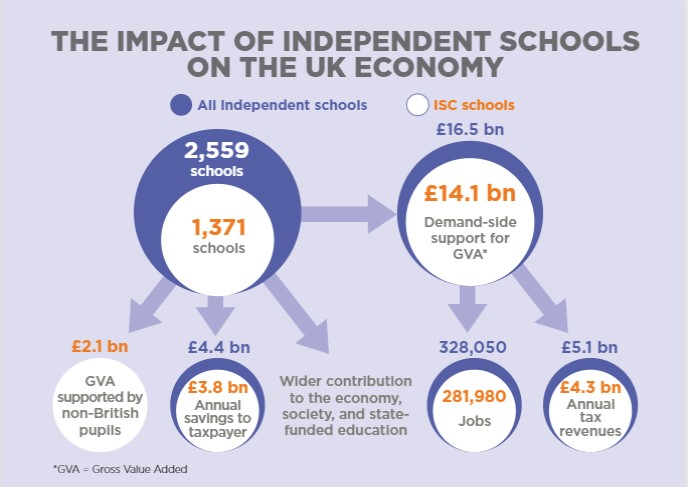
Similarly, the costings by the Labour Party suggest this policy will raise £460 mn in 2024-25, rising to £1.7 bn in 2029-30. A significant figure certainly, but dwarfed by the £16.5 bn brought into the economy every year by UK independent schools. The greater the impact of the VAT on independent schools, the more that larger figure may be jeopardised.
Why you should take notice
Yet still I suspect many people will shrug their shoulders, thinking this does not impact them or the people they know. They may be right, but the breaking of long-established principles should give us pause.
VAT is widely recognised as a regressive tax, meaning the poor pay disproportionately more. A recent study showed that the poorest 10% of society in the UK pay 12% of their income on VAT whereas the richest 10% pay just 3%. This particular use of VAT on school fees might give the illusion of targeting the wealthy but is in fact a blunt tool in comparison to taxing income or wealth directly. A willingness to try to increase tax income through VAT – perhaps by raising the standard rate, or by reviewing those goods and services that pay a reduced or zero-rate, or are exempt – could have far-reaching implications, especially for the poorer in society.
This erosion has now started. From the outset, when VAT was introduced in the UK in 1973, certain things were deemed essential and therefore exempt from the tax. Education was one of those things. That principle has now been broken and, given the government’s commitment not to raise income tax, we can question what other VAT-exempt services may be targeted. Just staying within the education sphere, now that it is established that education fees can be taxed, there must surely be a temptation to consider taxing the other main education fees which are currently VAT-exempt: fees for nurseries and universities. Let us consider one of these possibilities.
VAT on university tuition fees?
To its credit, the Scottish Government pays university tuition fees for Scottish students. This is not the case across the rest of the UK where students are required to pay annual tuition fees: £9,250 for domestic students, rising to £9,535 in August. Yet we hear of universities struggling. Cardiff University has announced plans to axe courses and cut 400 jobs. Dundee University has similarly said that job losses are inevitable.
Just five years ago, when he was standing for the leadership of the Labour Party, Sir Keir Starmer committed to abolishing university tuition fees as well as calling on the government to reintroduce maintenance grants. Now, under his premiership, university tuition fees have risen and there is no mention of the reintroduction of maintenance grants. Given this, we would be naive to disregard the possibility of VAT being added to university tuition fees. A similar philosophy could apply: the government claims it is using the money raised this way to raise standards across the range of universities or education more generally. This would impact a far greater proportion of society, with more than a third of 18-year-olds entering higher education.
I have heard two arguments against this happening, both of which seem rather flimsy. The first is that there is not a choice between state (fee) and private (fee-paying) universities so students can’t choose the free option. But of course, students make a choice to attend university; it is not compulsory. Thus, students make a choice to pay fees, just as the parents of children attending private schools make that choice.
The second argument is that most students do not repay their fees anyway, so raising the nominal amount they owe actually makes no difference. But changes to the student loan system lead the government to predict that 65% of students from the 2023-24 cohort will fully repay their loans, in contrast to just 27% of the 2022-23 cohort. But even this misses the point.
International students pay significantly higher fees than domestic students. The government’s own figures tell us that international students paid tuition fees of £11.8 bn in 2022-23. VAT of 20% on that would be £2.36 bn, significantly more than would be raised from VAT on private school fees. A tempting prospect.
This would be a controversial move and would impact more people than the VAT on school fees, but the messaging could be similar: taxing the well-off. No doubt it would be wrapped up in talk about how only those who could afford it would repay the full amount, so it is ‘taxing the wealthy’. Playing to a domestic audience. And of course, the politically astute thing to do would be to do this after an election victory, as with the private schools, so that the turmoil is done and fading from memory by the time of the next election.
The imposition of VAT on private school fees is causing considerable turmoil and distress albeit on a small part of society. I think it would be not only unkind but also unwise of those not directly impacted to be complacent.
More in education.


Subscribe to our newsletters
Each of our Bylines sends a newsletter every month and we also send out a ‘Best of Bylines, featuring a selection of the best articles from across the network