



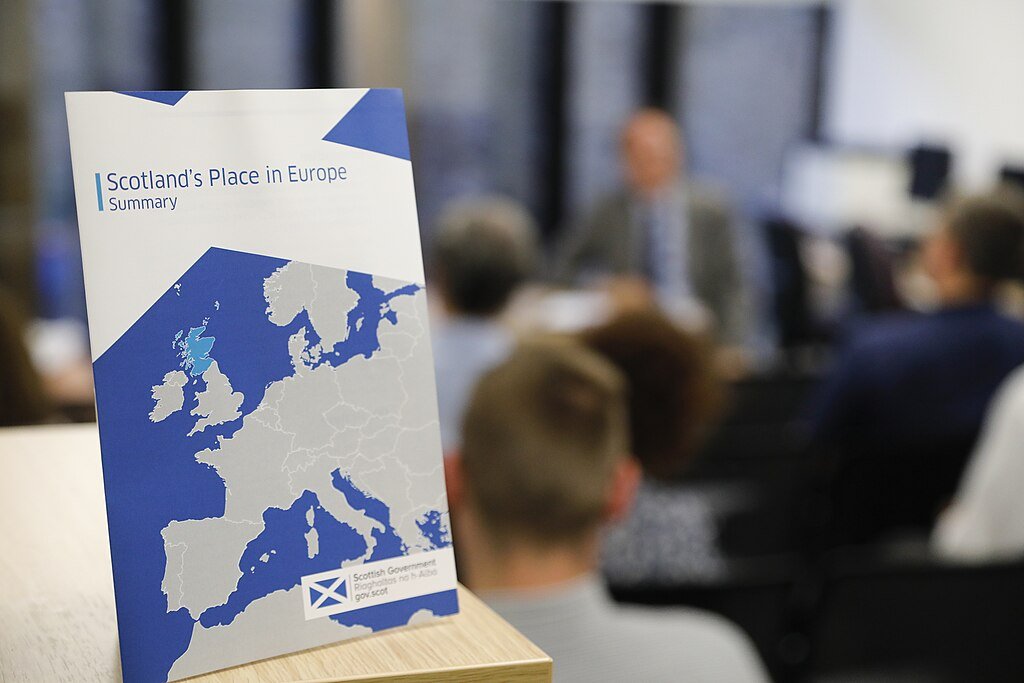
Scotland and I achieved an uncomfortable and unwelcome hat-trick at the end of June. Scotland Europa, the last of three bodies which spoke to the country’s place in the European mainstream, is being closed. The loss of Scotland Europa, and two other Scottish entities promoting Europeanism, leaves very serious questions about who we are as a nation, and where we are going – and they have nothing to do with constitutional or political differences, thus revealing more about our overall priorities.
Losing the scaffolding
Having been the spokesman for the Scotland “Stronger in Europe” Remain campaign in the 2016 Brexit referendum, my regret at the UK’s withdrawal from the European Union is on record. It remains undimmed now as it was on 31 January 2020 when we tiptoed out of the EU. While there has been no serious reckoning as to why one million Scots voted to leave, we have been able to reassure ourselves that the Remain vote was above 60% and spread (relatively) evenly across Scotland. Nevertheless, the years since have seen a steady retreat from our engagement with the EU and the partnerships and networks at every level that were the real meat and drink of membership. Now, three of the pieces of European scaffolding put there to support numerous aspects of a devolved Scotland will soon be removed.
I worked for six years in Brussels, before and after devolution, for Scotland Europa. The brainchild of a Conservative Secretary of State for Scotland, it was an outpost created within the framework of the enterprise agencies. Its stated aim was, and is, to network Scotland in Europe. The approach sees public, private and third sector interests lever their connections and presence to seek partners, funding and fruitful collaboration. On Wednesday 25 June it was announced that Scottish Enterprise will no longer be funding Scotland Europa from the end of March 2026, after 33 years of networking Scotland in Europe.
Losing 33 years of experience will be keenly felt
I have no doubt that the Scottish Government will wish to continue its presence in Brussels, albeit on a smaller footing and with very specific responsibilities. That does not diminish the loss of a one-stop shop for Scottish interests. We are losing our conduit to the EU’s national and regional representations in Brussels. That weakens our armoury across hundreds of commercial and policy interests within Europe’s centre of decision making and influence. Just as Horizon, the huge EU scientific and technological R&D programme, is restarting in the UK, very modest progress is being made on reducing some of the unavoidable new barriers to trade and cooperation, the sacrifice of 33 years of experience, reputation and contacts will be sorely felt.
This follows on from the folding last year of the Scottish European Educational Trust (SEET), of which I was honoured to be a trustee for more than a decade. A charity which operated for at least 20 years, it sought to improve knowledge of, and engagement with, our European nation neighbours – through language, general knowledge, film-making and other projects. Thousands of primary school children every year competed for the “Euroquiz” local heats, the finals of which were held, until recently, in the chamber of the Scottish Parliament. The Scottish National Centre for Languages honourably stepped in to keep some SEET projects running. However, it does not speak well of a country that a small, efficient, not-for-profit organisation that sought – apolitically – to expand the horizons and language skills of thousands of school pupils no longer merited a space in Scotland’s community.
Holyrood a lonelier place
The European Commission’s office in Scotland pulled down the EU flag for the last time in 2020. The European Parliament’s office, of which I was a proud Head for six years, held on to protect the interests of voting EU citizens, but it has also closed its office near Holyrood. I reflected at a conference on 25 years of devolution that the loss of the EU infrastructure had left the Scottish Parliament a lonelier place.
Many of the key devolved powers such as environment, agriculture, fisheries and aspects of law were shared with the EU. Members of the European Parliament (MEPs) provided a direct link to an elected assembly of every possible political persuasion with increasing influence in the EU political balance. At one stage, the European Parliament Office would host a regular information-sharing meeting between appropriate MSP, MP and MEP members of the two EU advisory committees – the Economic and Social Committee and the Committee of the Regions.
Irrespective of one’s political persuasion or apportioning of blame, and aside from constitutional wrangling, these losses are considerable. Businesses, public bodies, educational institutions and the third sector thrive on shared knowledge, timely counsel and sectoral expertise. To lose bodies that cater to all of these and future generations too, is more than a casual accident, and a concern for any nation, region, state or body of interests that holds and declares aspirations for connectivity and progress.
Closing our doors to the outside world
Scotland’s place in Europe has been built by many hands – far too many who are no longer with us. People like Donald MacInnes, Neil MacCormick, John Mulgrew, Kirsty Macdonald, Ken Munro, John Purvis, James Temple-Smithson, Alison Edwards, Campbell Christie – the list sadly goes on growing. It is a poor memorial and shows a poorer sense of aspirations and priorities that we watch our doors to the outside continue to close.
More in politcs:




