



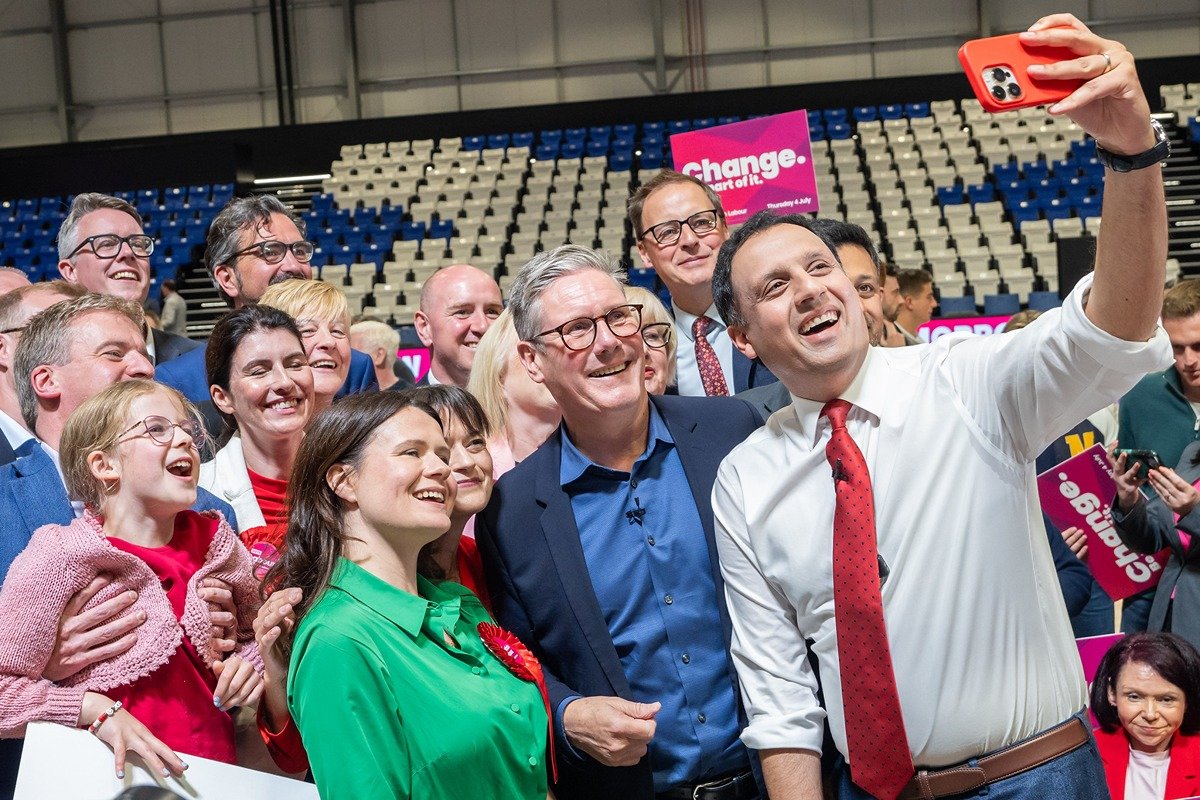
As voters increasingly tune out the now familiar post-election commentary, one explanation for Scottish Labour’s collapse has settled quickly into the media narrative: Anas Sarwar’s record low of 17 MSPs is Keir Starmer’s fault. The worst ever Scottish Labour Holyrood result. I mean, hold my drink.
Granted, Keir Starmer has led Labour like a dunked biscuit breaking off into your cup of tea – a tenure that is a mixture of disappointing/irritating/angering (choose your preferred response). Yet, to forego other reasons for failure in Scotland is to do an injustice to reality: Anas Sarwar, the man who would be king following Labour’s 2024 UK election success. Labour, those who bankrolled Labour operations, and a section of supportive media tried their best to portray him as Scotland’s inevitable next first minister during Labour’s brief honeymoon period.
Unfortunately, the elephant in the room was never mentioned. Anas Sarwar is not and never will be popular enough to overcome the political limitations of Scottish Labour and become first minister in Scotland.
Sarwar’s problem
Sarwar is a political chameleon that has little in the way of authenticity. What does that mean exactly? It means that he can only say what he thinks one of several groups wants to hear. Business? The tone shifts. Issues in the public domain? Poll-tested positions. On independence from London Labour? Unconvincing to voters who care about Scottish political autonomy. To constitutional moderates? Unconvincing since Brexit and so-called ‘muscular’ Unionism. Socialist principles? No common ground with the working class. Sarwar’s Labour is miserably managerial. You cannot build emotional loyalty around a claimed (and untested) capacity for so-called competence.
The ‘no common ground’ point is partly about class, but also cultural signalling, although people in Scotland are often uncomfortable saying this openly. Sarwar is wealthy, highly polished, privately educated, from a political family, and speaks in a very professionalised political style.
Scotland has elected and supported politicians who were not naturally ‘one of us’ figures in a traditional class-cultural sense. Ruth Davidson, for example, succeeded to a certain extent, despite leading a party many Scots disliked. She had a real purpose in her time at Holyrood – keeping the Union together. Sarwar has no real purpose other than being an alternative. Hardly inspiring, and, in any case, he would always be at the mercy of London, a weakness in any claim to authority.
His proclamation around Starmer needing to go validates that claim. Indeed, one political commentator told him that no one was listening. They were; he was heard but unheeded. It didn’t sound the starting gun on a leadership challenge; it was more of a damp squib. It showed again the lack of political clout of Labour in Scotland where it counts. Which faction is he aligned with? Where is his influence? Labour in Scotland is only of use when London decides. Voters simply do not know what he truly can realistically say or do that would materially change Scotland for the better.
A party still in decline
That he will continue as leader after such a dismal showing exhibits the sorry state of the once dominant party in Scotland. Sarwar’s problem is not simply that he leads Scottish Labour during decline. He has been playing his part throughout much of that decline. Appearing in 2010, deputy leader in 2011, leadership contender in 2014, leader in 2021. So, while it would be unfair to suggest he caused the recent collapse on his own, he’s certainly been in about it.
Scottish Labour’s decline is obviously bigger than one person: Iraq, deindustrialisation, the constitutional question, Westminster drift, the SNP occupying much of Labour’s old social democratic space. But politics is also symbolic. Voters usually want renewal to look and sound like renewal. Sarwar neither feels like change nor someone capable of disrupting the model in the way Jeremy Corbyn at least promised to. He feels like someone shaped by it, promoted within it, and still speaking its language. So when he says “change”, opponents can fairly ask: “Change from whom? You were already there.”
I wrote in ‘Boxing Clever’ that Sarwar’s rise looked more like a temporary political opening than the emergence of a future first minister. Recent events have largely borne that out. Scottish Labour briefly benefited from exhaustion with the SNP and the expectation that a UK Labour government itself represented renewal, but once voters began judging Starmer’s Labour in power rather than Labour in opposition, the limits of Sarwar’s appeal became clearer again. He still struggles to project the kind of rootedness, conviction and political identity that Scottish leadership politics tends to reward, and the deeper structural problems inside Scottish Labour were never actually resolved, only temporarily obscured.
Reading Labour’s palm
If Sarwar is all Labour has to offer, its prospects for the next election are grim. Reform is on the rise and Labour down south seems intent on eating itself from within. The sad and very public manoeuvring of leadership hopefuls will further erode its support. Gordon Brown will not save it; he looks ever more like a political dinosaur and not one that many of the public have very good memories of either. I’d be surprised if his presence in the political fray does anything other than add to the division of the party.
There are still over two years until the next election, and while a week is a long time in politics, we can make a canny guess at potential future scenarios.
Here’s mine. Sarwar will not be able to escape the ongoing leadership psychodrama the UK Labour Party will provide to the media, and importantly will have little influence on the outcome (though it is possible a faction may link up for their own gain). Nor will he be able to get much traction in Scotland, as Reform will not only get sensationalist headlines: it channels anti-political anger. Starmer now looks increasingly unlikely to survive politically to the next election. Labour will then lose in a ‘who knows what is going to happen’ UK election to Reform and the Greens.
The caveat is that we don’t know if Andy Burnham has the vision and support to get results before 2029. It is an interesting prospect for change in the status quo.
Nationalist opportunity
The SNP has a huge chance to demonstrate competence in these next two years. John Swinney – if he can make demonstrable inroads into some of the issues prevalent in voters’ lives – could project the SNP as the party of good governance again, laying the groundwork for a strong showing in the UK election. Should ‘next generation leadership contender’ Stephen Flynn make the right moves and demonstrate an appeal to voters that Sarwar will always lack, there is a real chance to persuade voters that Westminster must change tack on devolution.
Wales too is an important factor: its nationalist movement may build on recent success (at least the Labour leader had the humility to stand down), all adding fuel to the fire for independence or a new devolution settlement.
In almost every plausible political scenario, Sarwar still looks fundamentally unable to obtain the role he seeks. Yet he carries on regardless, pursuing a destination that remains as unreachable as Sugarcandy Mountain. He should go and Scottish Labour should renew. But then, I’ve been saying that since at least 2017. I am not the only one. To approach Scottish politics as an electoral management problem rather than a question of political identity and purpose is a recipe for continual disappointment.
More from David Anderson


Bylines Network Gazette is out!
The latest Bylines Network Gazette is out now. Become a Friend of Bylines Network or upgrade to a paid Substack subscription, and you will get access to a vital collection of citizen articles and stories.
Journalism by the people, for the people.