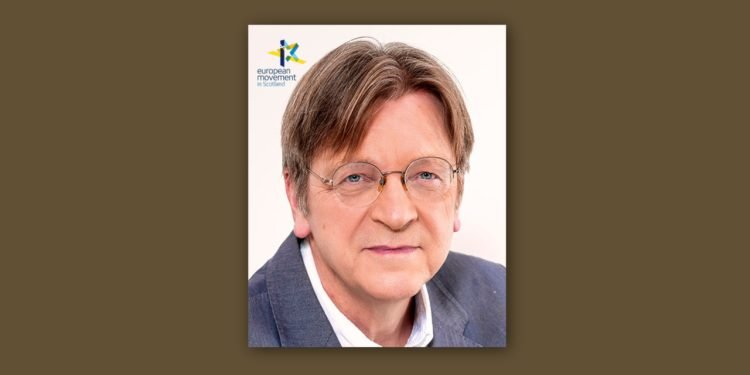
Nigel Farage is a conservative. He believes in a small state, in personal responsibility and the right of the individual to lead their life as little bothered by the state as possible. I haven’t asked the Reform leader if this is the case, but he’s been a politician for a long time now and in each of the parties he’s headed up, UKIP, the Brexit Party, and now Reform, the state, its size and its behaviour has been his core target. To sum up what I believe is his fundamental political philosophy, it is “big state bad, small state good.” If my interpretation is right, then Mr Farage should be a confirmed supporter of the European Convention on Human Rights.
The ECHR is one of the most misunderstood international treaties. It is not a creation of the European Union. Nor is the European Court of Human Rights (ECHR). The EU does not administer or run the Convention or the Court. Both operate under the umbrella of the Council of Europe. It has 46 member states, including the UK, which was a founder member, in 1949. All 27 EU states are members and so too are 20 non-EU states, including Ukraine, Georgia, Switzerland and Turkey.
The treaty exists so that governments that have committed to the terms of the ECHR are constrained from behaving badly towards their citizens. Member governments can also challenge each other before the court.
Many member states have adopted the provisions of the Convention into domestic law, as the UK did in 1998. The UK Act made it possible for actions under the ECHR to be heard in British courts.
Solitary, poor, nasty, brutish and short
The core question is why do we need a treaty and a court system to protect citizens from their governments? Throughout history, numerous rulers and governments have murdered, tortured, starved, stolen from, discriminated against, and been complicit in making life, in the words of the English philosopher Thomas Hobbes, “solitary, poor, nasty, brutish and short”, for, usually, the most vulnerable in society.
Governments almost always hold almost all the power. They control money, the army, police, secret service, courts, laws and all other arms of the state. The ordinary innocent citizen who falls foul of a malign state has very little chance against such might. The ECHR helps to redress the balance by ordaining a legally binding set of rights and giving the citizen a judicial mechanism to challenge their government in court when they believe their rights have been removed or diluted, so that independent judges can hear the evidence and make a ruling. Treaty and court act as a brake on governments inclined to misuse their powers.
History might have been changed
Had the ECHR existed during the Highland Clearances or the Irish Famines, history might have been changed. Thousands might not have been driven from the Highland croft and glen. A million may not have died in Irish fields and another two million forced to leave their homeland for ever.
In 16th and 17th century Scotland and England, over 700 women were burned to death for being witches. They might have lived had the ECHR existed. In Canterbury, in 1555, 79 Protestant martyrs could have continued to peacefully follow their religious belief, rather than their actual fate, which was to be burned to death. In 1676, in Edinburgh, 20-year-old Thomas Aikenhead was executed for blasphemy. He had questioned the existence of God.
Thomas Aikenhead was a rather naïve student who failed to understand that 17th century post-Reformation Scotland had a Church of Scotland that would brook no heresy. For simply saying what he believed, young Thomas died on the gallows. Power lay in the hands of the Church and state. Thomas was powerless. The law afforded him no protection.
In some African countries today, homosexuality is a capital crime. Gay people can be executed. Last year, the Afghanistan government said it would reintroduce stoning women to death. It’s only 80 years since Hitler killed six million Jews and many hundreds of thousands of Slavs, Roma, homosexuals, communists, social democrats, trades unionists, artists, journalists and just ordinary Germans accused of criticising the regime. A special death by guillotine was reserved for them.
It can happen here
Can such things happen here now? What if you’re of West Indian birth and came here as a child long ago and never imagined that in your 60s or 70s the UK government would seek to deport you, to be sent far away to where you may not know a soul, leaving family and friends behind in Britain? That’s what happened just a few years ago, in what became known as the Windrush Scandal. Other UK scandals where government has been reluctant to admit wrongdoing include the contaminated blood issue, the 1994 Mull of Kintyre helicopter crash and 1950s servicemen exposed to nuclear contamination.
The ECHR helps protect ordinary people. Like all law, it may have its flaws, but before you consider supporting the UK leaving the Convention, remember that it might be you that hears the dawn knock of the secret police. It can happen here.
Among the provisions of the ECHR are the right to property, the right to education, the right to free elections, the prohibition of imprisonment for debt, the right to freedom of movement and the right to compensation for wrongful conviction. At this very moment, the UK government is guilty of not compensating people who were jailed for long periods and have since been proven innocent. A British Human Rights Act may see them never get compensation, because the British government won’t admit it can be wrong.
Voluntarily giving up rights is akin to a bank manager providing a safe breaker with the combination codes to the safe. The robber won’t be satisfied with a few thousand pounds. They’ll take it all. And that’s what governments are likely to do if we hand them the combination codes to our freedoms.
If Farage believes in freedom, he should support the ECHR.
Martin Roche sits on the national executive committee of the European Movement in Scotland.
First published in The Herald, Sunday 14 September 2025.
More on politics: