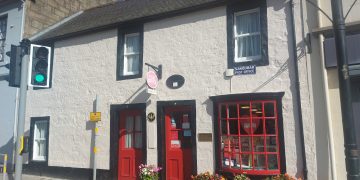
As winter is, once more, consigned to history and Scotland sails toward spring, I look back at a winter’s trip to Dunfermline, a city that is much underrated and deserves more credit and attention than it receives in the media and tourist publications, at least that I have seen.
I didn’t expect much from my visit to Dunfermline, only that it would be the starting point to my first Scottish winter walk of the new year. Why? Simply because I’d never heard anything about it. People talk about Aberdeen, Glasgow and Stirling. They talk and talk about Edinburgh! Yet I never hear talk of Dunfermline, its beauty or what it has to offer. That’s why, when I arrived on the fifth day of 2026, I was pleasantly surprised.
Dunfermline Abbey
The morning sun illuminated the ancient Dunfermline Abbey, creating an image of such beauty, that it might be the kind of image to be featured on a jigsaw puzzle, an expensive picture or a calendar. The orange glow covered the old stonework, bathing it in a golden glory that complemented the winter’s morning in a way that nothing else could, as if the heavens were showing approval in giving this historical structure a golden halo.
The abbey is currently a parish church belonging to the Church of Scotland, standing on the site of an ancient chancel and transepts of a large medieval abbey. This Benedictine Abbey was founded in 1128 by King David I of Scotland, but the monastic establishment was based on an earlier priory which dates to the period between 1058-1093, during the reign of his father. In 1560, as part of the Scottish Reformation, Dunfermline Abbey was sacked and allowed to fall into disrepair, yet parts of it survived including the transepts and the nave, the latter of which now serves as the vestibule of the church.
It is a building with so much fascinating history and beauty, this alone should be enough to draw visitors to the city, yet it is only one of the other wonders of Dunfermline.
Pittencrieff Park
Frost, ice and a light dusting of snow covers the grass, trees and pathways in the park, like icing sugar on a cake. A stream winds its way past leafy embankments and walls of natural rock in this forested valley in the heart of Dunfermline. This is Pittencrieff Park, a place of nature and wildlife, history and heritage, child friendly activities and, of course, my favourite, walks.
Pittencrieff Park was once known as ‘Pittencrieff Estate’, previously owned by Colonel James Maitland Hunt, before it was purchased in 1902 by Andrew Carneggie with the wish to gift the estate to the people of Dunfermline.
The contrast of the green of the trees against the thin layer of white atop the grass, the leaves and the stone walls is breath-taking. It is the perfect example of a priceless and picturesque Scottish winter.
Malcolm Canmore’s Tower
But it isn’t only a natural oasis. History abounds in the park that houses the remains of Malcolm Canmore’s Tower. Malcolm Canmore, also known as Malcolm III of Scotland, was the eldest son of King Duncan I. Born in 1031, he reigned for 35 years from 1058 until his death in Alnwick, Northumberland and was buried in Dunfermline Abbey. He was succeeded by his son from his first marriage who became Duncan II of Scotland.
The first historical record of the tower dates from 1070, when Malcolm Canmore celebrated his marriage to his second wife, Queen Princess Margaret. It was subsequently adopted as the burgh arms of Dunfermline and old wax seals show it as a building of two stories and an attic, containing some 20 small apartments.
Historical poerty describes the tower as a place where the king sits in Dunfermling Toon, drynking the bluid-red wyne”.
A must-see city
Dunfermline Abbey and Pittencrief Park are only two of the amazing and must-see places in the fascinating city of Dunfermline. The city, once the de-facto capital of the Kingdom of Scotland between the 11th and 15th centuries now has many entertainment venues, places for fine dining and endless opportunities for sightseeing. For me, I only wanted to see a new town, but the sights and history I found far exceeded my expectations and the city I previously knew nothing about, finally blew my mind.
More on history: