The story of immunisation goes a long way. From innovative practices in the fifteenth century to the new technologies used in the Covid-19 vaccines, humans have always tried to find ways to prevent them from contracting and spreading diseases. All of it with the aim to provide a global vaccine for when pandemics struck. Nowadays, immunisation has been responsible for reducing mortality rates in children by over 50%.
It is galling to see the increasing number of vaccine deniers, fuelled by social media, and it is infuriating to me that some parents deny their children the right to be vaccinated, unless there are health issues involved in both cases. The worry of the side effects a vaccine can induce is understandable, but are these vaccine deniers performing their research appropriately, using trustworthy, factual sources? Do they try to find about toxicity levels, methodologies and the type of adjuvants (substances added to vaccines to improve immune response towards the pathogen) used? It is clear to me that science should be made more accessible and transparent to the general population when it comes to new discoveries.
How do the vaccine deniers propose that we all live in a healthy society if having adults immunised is the most cost-effective public health preventative intervention available? It not only increases returns on investment at the individual level, but also for the healthcare system and for the economy and society in general.
Vaccination coverage
For those involved in the area of immunology and infectious diseases, there is celebration of the fact that we currently have 25 available vaccines and 15 under development against diseases. It is sad and disappointing to know that a proportion of citizens are not taking advantage of this incredible achievement. Vaccination coverage is normally lower in adults than in paediatric vaccination programmes. Vaccine-preventable diseases (VPDs) are the main obstacles for a healthier and wealthier society. Thinking economically, VPDs also increase the risk of cardiovascular, neurological, and renal complications. Our whole health system will soon lack resilience, if it hasn’t already. Despite all this, approximately 100 million doses are estimated to have been missed in 2021-22, during the height of the Covid-19 pandemic.
Looking at the facts, seasonal influenza epidemics lead to 3-5 million hospitalisations and 290,000-650,000 deaths globally. In the European Union, VPDs are to blame for 94,000 deaths annually. When we look at the excess deaths in England linked to influenza, they were higher in the 2022-23 Flu season than in the previous five years. Up from 13,500 to 14,500. Hospitalisations were higher and across all age groups than average. In Scotland there were 340 additional deaths of Influenza and 310 of Covid-19 in winter 2022-23 compared to the previous winter. The Covid-19 pandemic was one of the reasons for the lower rates of vaccination and increase in the number of deaths. But what about Covid-19 immunisation from now on?
Low rates of immunisation is not only due to vaccine deniers but to the policies of governments too! And in this case, inexplicably, mainly governments from rich countries. There is no excuse. It is inhumane and unethical.
Covid-19 vaccination in the UK is no longer a priority
The 2023 Nobel Prize in Physiology or Medicine was awarded to Katalin Kariko and Drew Weissman for their discoveries concerning nucleoside base modifications that enabled the development of effective mRNA vaccines against Covid-19. However, the momentum that should have been kept to strengthen the public health value of vaccination and the discoveries scientists bring to society seem not to be valuable for our governments here in the UK now.
I was astonished when I learned that the current Covid-19 vaccination programme was only going to cover a small percentage of the population. Following the Joint Committee on Vaccination and Immunisation (JCVI) advice, only adults aged 65 years and over, residents in care homes for older adults, frontline health and social care workers, carers, and people who are immunosuppressed aged from 16 to 64 years and their household contacts are entitled to receive the vaccine in the UK in autumn 2023. While in countries such as Canada, United States and Brazil, the entire population is receiving boosters.
With no doubt, this raises red flags for me. We know very well that the virus is still evolving, with the appearance of numerous different strains. Therefore, clearly our best approach would be to vaccinate as many people as possible. What are the thoughts behind this decision? What was the reason to apply a “non-standard method of cost effectiveness” assessment? It is vital to vaccinate the vulnerable since their immune system is not as efficient as it used to be. However, we know well that their response to the vaccine is not 100% either. And with this thought in mind, I would argue for the importance of having the rest of the society vaccinated as well. It adds another layer of protection to the vulnerable population. Why is the vaccine programme for Covid-19 not the same as the one for Influenza? Why are our governments allowing its citizens to become infected over and over again, leaving them more susceptible to Long Covid?
Covid-19 vaccines stockpiled and more questions than answers
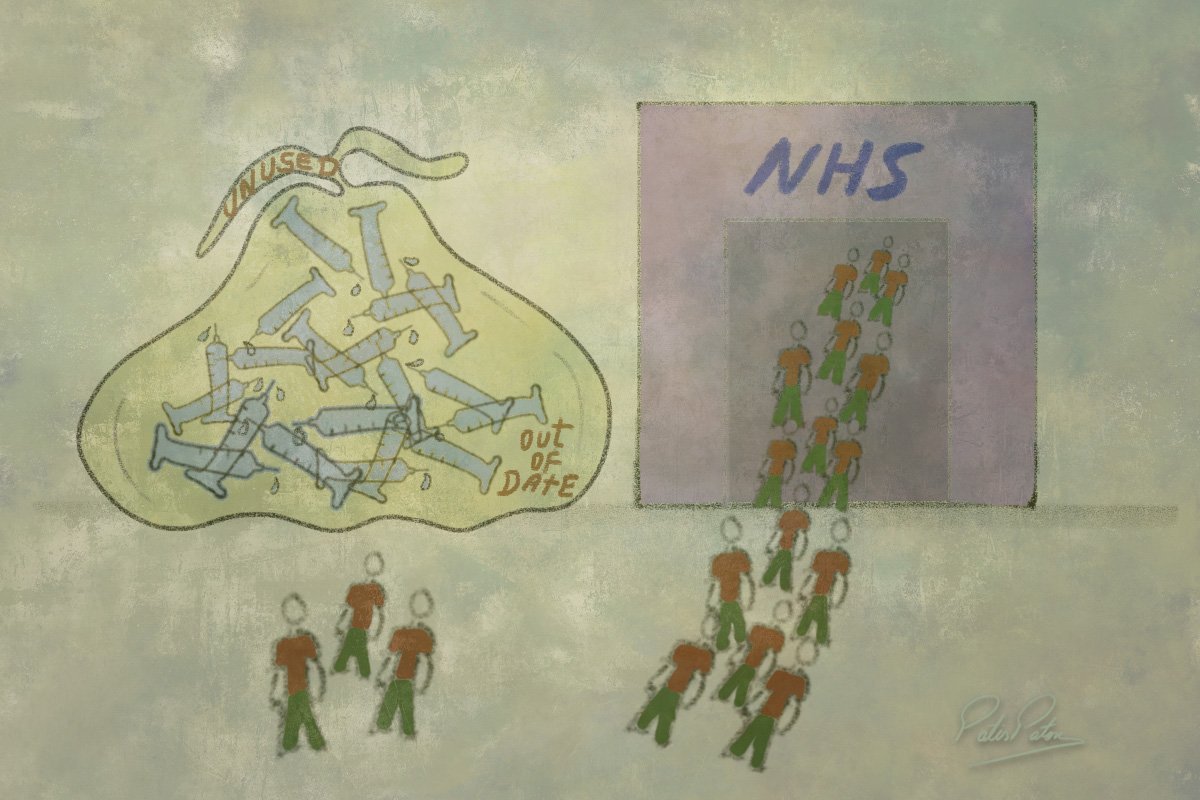
Instead of simply being astonished by the news that millions of doses of vaccines have been stockpiled in case of an urgent need ie a massive deadly outbreak which threatens to cripple the NHS, this time I’m outraged. Are we still following the ridiculous notion of acting only when seriously needed? No prevention controls are worthwhile? What are the governments falsely trying to save? Money or citizens? What are the half-life of these vaccines? Purchasing them then not using them and eventually throwing them in the bin is considered more economic, or even better, ethical? Is Scotland devolved with regard to health or not? Why is its Government following suit the UK Government’s policies? Don’t they have their own vaccines, in other words, don’t they have a quota of purchased vaccines based on the Barnett formula share? Why doesn’t Scotland have its own JCVI?
Governments still get away with no punishment
The question that is lingering in the back of my mind is how such governments are still allowed to be in power, as they present a serious health and safety hazards. The ongoing Covid Inquiry has clearly shown their ethics and respect for their fellow citizens…and what they think about science, as we learned from Sir Patrick Vallance when he mentioned:
“Boris Johnson was clearly bamboozled” by scientific concepts.
“Scientific advisers were not consulted in advance about the Eat Out to Help Out scheme.”
Johnson had been “very sceptical” about Long Covid, and briefly suggested the virus should be allowed to “rip” through the population.
Almost four years since the pandemic started, and I had managed not to get infected. Unfortunately, the virus finally got me a few weeks ago after my daughter got infected by it at school. I have to say the experience wasn’t good. As soon as I tested positive I started to think, as an immunologist, about how the virus was using my body. And since then, I’ve been trying to avoid any scientific paper that shows further what this virus is capable of doing to us human beings. I fall into the age bracket where my immune system is not strong – the over 50s. Why wasn’t I entitled to make a choice? Let me repeat an old public health mantra – why are air filters not deployed all year round in schools and busy public places? I will never forgive this Government for shortening my life expectancy and I really hope that I won’t be a burden on the NHS if, in the near future, I am presented with sequelae from this infection, just as many thousands of others already have been.
Worse than my feelings of getting infected at my age, is that in 2025, an unvaccinated child has died in Texas, United States, where there is a measles outbreak. What a regression, and a perfect example of a policy based on pseudo-science…
Editor’s note:
This article originally published on 23 November 2023, was updated on 27 February 2025 to reflect the death of a child infected with measles virus in Texas, United States.
More in health.