



As a kid I used to love Guy Fawkes Night – bonfire night. It was the best night of the year. A massive fire. Parched peas (black peas in vinegar if you’re not from Lancashire). Parkin. And of course, fireworks!
But as a child I knew nothing of the impacts of bonfire night. We meant no harm, scaring folk with bangers. What harm was there in burning a stack of old wood? And who cared about the noise of the fireworks? This was bonfire night – it was meant to be raucous!
Over 40 years and a career in ornithology later, I understand all too well the impacts that we humans have on the environment. You have only to search Google Scholar to find numerous scientific studies on the impacts of light and noise pollution on birds and other wildlife.
Harm to animals and wildlife
We’ve long been told to keep pets indoors on bonfire night (The Kennel Club estimates 80% of dog owners say their pets are stressed by fireworks). In recent years people have been asked to check for hedgehogs and other animals that may have moved into bonfires for shelter and safety. I think most people give little more than a cursory glance around the outside. I mean, how do you check a stacked bonfire that’s 20 feet high and wide?
The impact on animals, livestock and pets is viewed as secondary to our own enjoyment. This year, however, the impacts, particularly the noise from fireworks, made national news with the death of a baby red panda at Edinburgh Zoo which choked on its own vomit as pyrotechnics were set off across the city.
Local concern but a national problem
Here in Orkney, residents have long been concerned about the impacts the islands’ main bonfire event has on the environment. The bonfire night event is held adjacent to a small body of water, the Peedie Sea, on the outskirts of our county capital, Kirkwall. The Peedie Sea is used by many wildfowl, including both Mute and Whooper swans, to feed and for night-time roosting. During the week before the 2024 event, over 30 bird species were recorded using the site. It’s their safe space – apart from one night a year when the annual bonfire event is held.
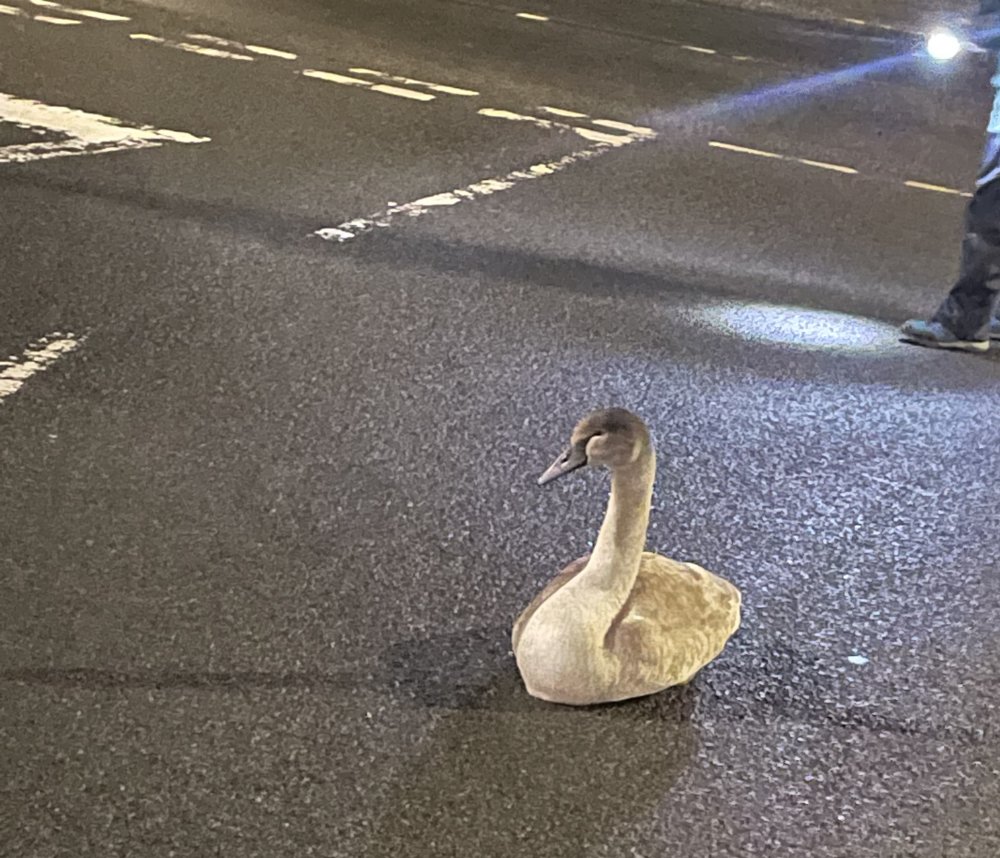
Things came to a head at the 2023 bonfire event when spectators witnessed families of swans and other wildfowl fleeing the Peedie Sea. They were flying low over their heads as the birds, confused by the lights and noise, looked to return to their safe place with nowhere else to flee to. So, they tried, repeatedly, to return to the Peedie Sea only to be scared off again and again by the continued light and noise of the fireworks. One young Mute Swan crash-landed on to a nearby road, where a member of the public rescued it and safely reunited it with its family after the event had finished.
Local campaigning
After the 2023 event, residents formed Team Swan to campaign against the Peedie Sea being used again. They immediately lobbied the organisers – the Rotary Club of Orkney and Kirkwall & St Ola Community Council – and Orkney Islands Council (funder, landowner and licensor), Police Scotland, and animal welfare and wildlife charities SSPCA and RSPB, about the disturbance the bonfire night event was having on the wildlife using the Peedie Sea. Team Swan’s aim wasn’t to get the annual event scrapped, but to work with the organisers to find an alternative site that wouldn’t cause such distress to wildlife. Their online petition asking for the event to be moved gained over 2,000 signatures – that’s nearly 10% of the county’s population and four times the number who attend the event itself.
Earlier this month, following assurances that concerns had been taken on board, the bonfire night event was again held at the Peedie Sea with a reduced pyrotechnics display using “quieter” fireworks. Team Swan monitored the event, and when the fireworks were set off, the expected happened – all the birds using the Peedie Sea were again sent fleeing, panic-stricken and confused. And again, we had a young Mute Swan casualty, this time flying into a fence. That week’s front-page headline in our county newspaper, The Orcadian,read “Bonfire night branded ‘sickening sight”.
Locals opposed to the event want to know on what grounds have alternative sites been ruled out? And whether the criteria used for those sites have been applied to the existing Peedie Sea site? And they want to know why both the SSPCA and RSPB continue to be silent on this when the welfare of the animals using the site clearly falls within their charitable objectives.
Breaking the law
The organisers continue to hold the event at the Peedie Sea site knowingly causing “wilful disturbance”. They are clearly in breach of the Wildlife and Countryside Act 1981. In the weeks since this year’s event, Team Swan, myself as the county bird recorder for the Orkney Isles, and many other residents have again lobbied the organisers, councils, police and animal welfare charities about the continued wilful and unlawful disturbance. The online petition has also gained the support of a further 700 concerned individuals.
I imagine Orkney is not an isolated case. I expect residents up and down the country are distraught at the continued impacts on people, pets, livestock and wildlife, just for the pleasure of a small percentage of our population. In addition to the localised light and noise pollution, what of the combined air pollution from fires and fireworks across the country?
Ban the private sale and use of fireworks
On looking for online resources available to organisers, I found little or no mention of the impacts on wildlife, and too few on the impacts on pets and livestock. For example, the Explosive Industry Group’s 72-pageWorking together on firework displays contains no mention at all of wildlife and only three mentions of animals and livestock, making these and similar guidelines unfit for purpose.
Sarah Owen (Labour MP, Luton North) has a Private Members Bill going through the UK Parliament to restrict the sale and use of fireworks. Personally, I think they should be banned outright. We live in a technological age where light displays are now common. Lasers and drones are increasingly used in place of traditional fireworks for celebratory events. Technology is safer, and an outright ban on all private bonfires and use of fireworks in favour of community-run events using lasers and drones would see a huge reduction in A&E admissions with bonfire night-related injuries each year, estimated to be around 2,000 in England alone in 2018/19. The country would save the significant cost to the emergency services and NHS caused by bonfires and fireworks.
We’re living in a climate crisis, but we’re equally living in a biodiversity crisis. Humans have pushed species to extinction and once-common species are in steep decline. It’s time we reduced our impacts on the environment at every opportunity. It’s time we stopped putting our pleasure ahead of the lives and continued existence of other species.
More in environment.


Subscribe to our newsletters
Each of our Bylines sends a newsletter every month and we also send out a ‘Best of Bylines, featuring a selection of the best articles from across the network