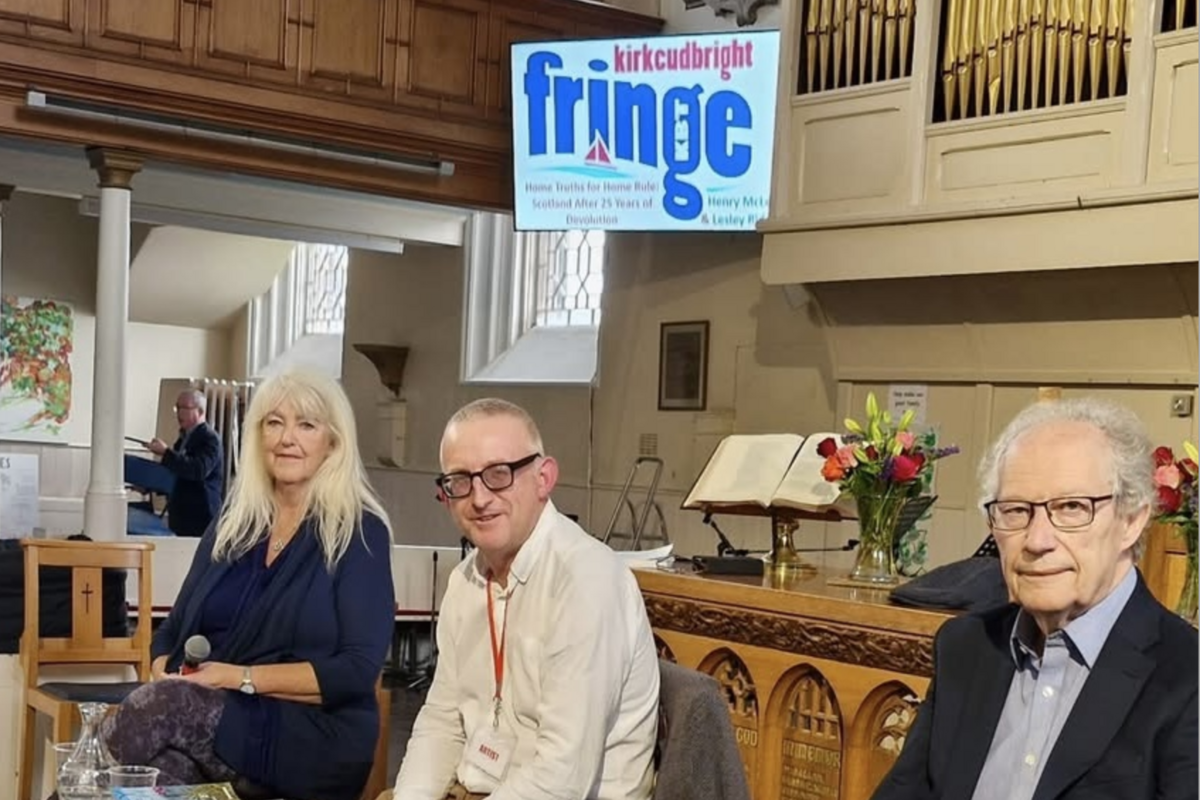
At the Kirkcudbright Fringe Festival last week, writer and broadcaster Lesley Riddoch and former First Minister Henry McLeish led a discussion on Scotland’s constitutional status and possible direction after 26 years of devolution.
There was a lot of discussion about Reform in particular and the rise of the right in general. One possible scenario outlined was that, in a general election, Reform gets some popular vote in Scotland but not enough to gain a single seat in a first-past-the-post race. Meanwhile, they win at a canter in England, and Farage becomes Prime Minister. Such a not so inconceivable scenario would be a version of the 1992 election, when the Tories were wiped out in Scotland, but who governed a pre-devolution Scotland on steroids. What possible legitimacy would such a government have to impose its agenda north of Gretna? And yet it would try to. And what would that mean for devolution?
Polls suggest that the SNP is within striking distance of the overall majority in 2026 which First Minister John Swinney stated would be a mandate for a second referendum. Certainly, this extraordinary change of fortunes might owe more to defections to Reform from Labour and the Tories rather than an increase in support for the SNP. But throw an independence-curious Jeremy Corbyn into the mixer and you have one of the most intriguing rounds of Holyrood elections since, well, 1999.
Legitimacy or democratic deficit?
Henry McLeish talked about a legitimacy deficit rather than a democratic one, but in the described scenario, I suspect this would just be semantics. What both protagonists in Kirkcudbright agreed on was that Scotland needs to push more to the outer limits of devolved powers. In other words, don’t just accept the narrow (narrowing?) limits of devolution.
Riddoch talked about the frustration of Scotland stubbing a figurative toe as it tried to develop policies that inevitably hit the wall of reserved competencies, including over immigration policy. This policy was criticised for being far too restrictive for an aging demographic. It also continues to hurt sectors such as farming – like dairy and soft fruit – which rely so much on migrant labour to ensure the success of a Scottish industry worth approximately £16bn per annum.
Indeed, Riddoch argued, and McLeish agreed, that the best way to protect and grow our democracy is to use our powers to the nth degree and beyond. That’s something that arguably hasn’t happened since the late Alex Salmond was First Minister, and that may be one factor why the dial on independence has been hard to shift beyond its now decade long stasis.
But what does this mean in a human level?
Yesterday I spoke with good friends living in England – he’s an Aberdeen boy, she’s of Jamaican/Irish decent. They’re a couple with mixed race children who’ve been watching the mercury rise for a while. They definitely felt the eye of suspicion when they were the only folk in the street who refused to put the bunting out and join the street party during the coronation. And that was three years ago. Recent events didn’t come from nowhere.
They are considering their options ahead of a Farage premiership – Scotland maybe? But then you read reports from Glasgow at the weekend; the noticeable increase in “flegs” and detect more folk on social media feeling emboldened to say things that they wouldn’t have gone near a couple of years ago and you think: are ‘we’ that much better?
We need to guard against moral exceptionalism. I’d like to think ‘we’ are the proudly, mongrel nation that the great Willie McIlvanney talked about, but if we are then we need to walk the walk as well. Let’s not just boast, then cower.
True colours
Maya Angelou used to say that when people show you who they are, believe them the first time. Scotland needs to show the world what it is, because we won’t get a second chance. We’ve wasted a decade and more by failing to really create a consensus around independence, and I get that that needs to happen. The packed venue in Kirkcudbright is proof that people are up for it and taking a diametrically opposite worldview to Nigel Farage et al would be a positive move as well.
And while the Yes Groups are a proudly grassroots movement, it’s important that political leaders set the tone. The friend I mentioned above used a German word to describe ex-Liverpool manager Jürgen Klopp – “Menschenfänger“, literally “people gathered”, someone who sets the bar, who gets people buying into a culture. That’s what I think the First Minister needs to do. It’s not enough to just be a wee bit better than the noisy neighbours.
There’s a line in The West Wing where Josh says something like, “we talk about our opponents more than we used to”, and perhaps talking about Farage all the time just makes it worse. Better perhaps to ask instead – what do ‘we’ stand for? And how do we create a constitutional structure that provides us with the agency to become the best versions of ourselves?
And, as the title of the Kirkcudbright debate alluded, that belated journey starts with a few home truths.
More on politiics: