
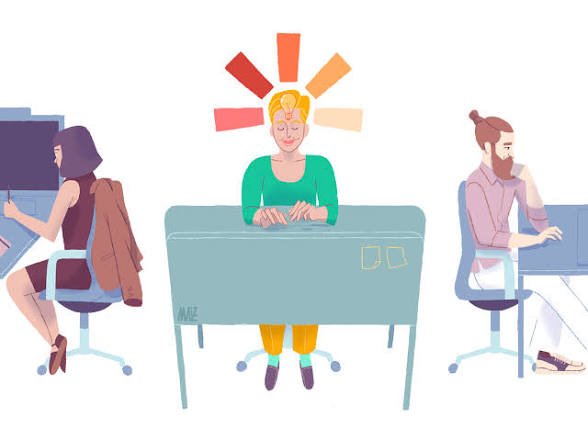
According to a survey conducted among over a thousand people, 65% of neurodivergent workers feared discrimination as a result of their condition(s). This figure only accounts for fear of discrimination from management, however. 55% of respondents feared the very same from their fellow workers.
Whatever way you cut it, the majority of neurodivergent people are pushed away because of the way their brain is wired. The question must be asked: why are they driven into fear and not pulled into a more inclusive workplace?
Getting through the door
From discussions I have had online and with those close to me, one consistent theme has appeared: the traditional interview structure.
Traditional interviews focus on a 30-minute conversation; online interviews have made this easier, but that doesn’t address the core issue. It’s no secret that verbal communication is a difficulty with all kinds of neurodivergence. While everyone across the spectrum will have their own unique difficulty, something that unites a lot of people is the challenge of reading between the conversational lines.
Understanding what an interviewer wants to glean is challenging, and it’s nothing short of a tragedy that key skills and qualities are being overlooked because a question wasn’t posed right. When I asked an autistic community about this topic, one person noted that interviews focusing on demonstrating one’s ability could not only be easier for the interviewee but also more beneficial for the interviewer, as it could potentially be a better indication of one’s skill set.
Recent job listings that invite accessibility adjustments are a step in the right direction, but it may only work as a minor fix to a much larger issue, this being the evidently flawed interview process.
Feedback and framing
Getting feedback on some work you have produced and it being negative is not always the easiest to deal with, and this is exceptionally true for the neurodiverse.
Neurotypical people (that is, people who do not have any spectrum disorders) do not consistently receive negative feedback the way that neurodivergent people do, as a result of their difference. Any addition to this can feel like an expectation of failure, leading to a cycle of internal troubles. It is no surprise, then, that 3 out of 4 neurodivergent workers prefer to choose to minimise their time in the office through hybrid or remote work.
Further, feedback can be given in a way that is not easily understood, and as a result, actionable steps cannot be correctly taken. Ultimately, the issue with feedback is one of framing. If given in the right way, feedback can be both actionable and much easier to process.
Victoria Tretis’ blog post on the subject provides great in-depth detail of how this exact issue manifests. Notably, she states: “Vague feedback will lead to vague results, so be as detailed as possible”, which I personally find to be deeply true, being someone who often struggles with the fine details.
The removal of vague communication can unlock a vast amount of previously unrecognised talent. When clear steps are laid out for a neurodivergent worker, there is less room for interpretive guesswork that would otherwise take place.
Failures of diversity training
Companies are quick to express their desire for a diverse workforce, be it for the benefits that come therein or just for the positive image they receive. But saying is a whole lot easier than doing, and when it comes to actually picking the talent they claim to seek, they fail.
This is something noted in Equal Value Thinking by its founder, Jay. He states, “Inclusion for everyone, not just the neurodivergent, is how we solve this challenging problem.”
It’s particularly concerning to see businesses focusing too hard on one subset of people. Neurodivergence, while it certainly comes with its strengths, cannot be uplifted in a workplace alone; everyone must be. It is a consistent theme, not just in the workplace but in society as a whole, that if you want to uplift some, you have to uplift everyone.
It is not necessarily that everyone benefits from diversity; it is that everyone should benefit from diversity. Steps must be taken to empower all workers, and their specialties should all be recognised, so that all the gains received are not a by-product, but a goal.
What we can change now
There are many schools of thought on how to best accommodate a group of unique people. There are wide-ranging policies or even societal changes that could, and should, take place. But, first and foremost, the thing we can change now is very simply kindness.
To be kind is to have patience and respect for other points of view. If you listen, you could benefit a great deal.
Neurodiversity can refer to a wide range (spectrum) of conditions, and the author recognises that no two people within this spectrum are affected the same. A wide range of definitions on the subject can be found online.