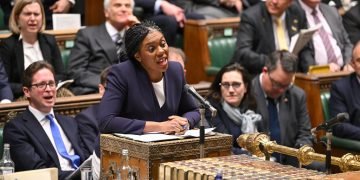




The Council of Nations and Regions met for the first time on Friday 9 October, in Edinburgh. The meeting caused hardy a ripple of media attention and brought little clarity as to what the prime minister’s new body is for. Keir Starmer said the UK should “harness” the different identities in the country. But it’s a safe bet that it is not a machine for strengthening Holyrood. The very opposite, in fact.
Scotland is to be seen by Westminster as having the same status as an English region. Those around the table at the Edinburgh meeting would be treated as “equal voices” said Sir Keir. Alex Salmond thought differently. In what was probably his last social media post, he wrote, “Scotland is a country not a county.”
It is worth reminding ourselves of the words of Labour’s Donald Dewar at the opening of the Scottish Parliament in 1999. Dewar, a man of great intellectual gifts and of unimpeachable integrity, was not prone to hyperbole. He knew his Scotland; its moods and tides, its history and its essential seriousness.
“Today, we reach back through the long haul to win this Parliament, through the struggles of those who brought democracy to Scotland, to that other Parliament dissolved in controversy nearly three centuries ago.
“Today, we look forward to the time when this moment will be seen as a turning point: the day when democracy was renewed in Scotland, when we revitalised our place in this our United Kingdom.”
Labour, Donald Dewar’s party – the party that proudly delivered devolution to Scotland – has concluded it doesn’t like this uppity legislature very much at all. It was the SNP (led by Alex Salmond) winning Holyrood that almost ended the United Kingdom and saw the country come close to seeing the Labour party eliminated north of the border.
Labour is determined that never again will it be reduced to a rump in Scotland. Part of reaching that state is the emasculation of Holyrood. Stage one is to build support for directly elected regional mayors. It would mean a wholesale reorganisation of local government. Labour points to the success of Sadiq Khan as London mayor, but more often to Andy Burnham, the Labour mayor of Greater Manchester Combined Authority. Manchester, like Glasgow, is a post-industrial city with a hinterland of smaller boroughs with similar problems to many of those that ring Glasgow.
Don’t doubt Labour’s enthusiasm for a new tier of local government and a new breed of powerful political leaders in Scotland. This is what Labour’s 2024 general election said.
“As well as a fairer funding formula for local government, Scottish Labour’s plans for reform within Scotland include a Local Democracy Act that will allow for the creation of regional mayors and support greater co-operation across regions.”
The Greater Glasgow region would likely take in every local authority district in West Central Scotland. A mega-city of some 2.5 million people. The mayor will have extensive executive responsibility. Schools and further education, transport and roads, policing, social work and social care, planning, economic development may all come under the mayoral remit. In short, huge budgets and huge power.
The Greater Manchester strategic model
What would it look like? Well, the Greater Manchester Combined Authority covers 10 local authorities and has an annual budget of some £2.6 bn. It is run by a core group of a directly elected mayor and 10 indirectly elected representative of the ten councils in the greater Manchester area. Each of these latter members has a policy delivery portfolio that follows the strategic path set down by the mayor.
The mayor draws his political legitimacy from being directly elected, having specific powers conferred by Westminster and in the high public profile that comes from being the political boss of such a huge part of Northwest England. The area has a population of close to three million people.
For all its size, economic clout and political weight, Andy Burnham’s Manchester is no threat to the future of the United Kingdom or the authority of Westminster. It is just one of many large conurbations and rural districts that make up a political England of some 56.5 million people. There are no credible movements for cessation from the UK in any English region. Scotland is different.
Scotland voted 74.29% for a Scottish Parliament
The new Scottish Parliament at Holyrood came into being 25 years ago. Its creation is to be found in a 1997 manifesto commitment by Tony Blair’s Labour party and in the 74.29% majority vote referendum later that year that asked Scottish voters to endorse the Blair government’s policy. It is the 1997 general election victory for Blair and the referendum vote by the Scottish people that give legitimacy to Holyrood. Plus, of course, Holyrood elections are done using a proportional representation system, so every vote counts in the Scottish parliament elections.
Holyrood Labour-led coalitions held sway until Alec Salmond’s SNP became the largest party in parliament at the 2007 Scottish general election. It has run the Edinburgh government since. Its time in power saw Labour reduced to being the third largest party at Holyrood and, in the wake of the 2014 independence referendum, the SNP crushed Scottish Labour as a Westminster force. Almost 100 years of Labour dominance of Scottish politics was ended. Its party machine became a shadow of its once all-conquering self.
Labour’s PR campaign for regional mayors as begun
Labour’s PR machine has already begun to promote the idea of regional mayors in Scotland. The Herald, The Scotsman, and The Spectator have recently carried articles and comment pieces on the subject. Labour MPs and councillors can be relied upon to step up criticisms of all local authorities not in the party’s control. It is no accident that none of the leaders of Scotland’s great cities were invited to the Edinburgh meeting of the Council of Nations and Regions. Nor was the Convention of Scottish Local Authorities.
Labour will deny it has any intention of infantilising Holyrood. Indeed, it will argue that as it hopes to be soon the biggest party in the Scottish Parliament why would it want to reduce its status, competences and powers.
Scotland is too small for Holyrood and giant local authorities
But here’s the rub. There is not room in little Scotland for huge regional authorities covering the great cities and their surrounding towns and villages and for the Holyrood Parliament and Scottish Government. That is why the old regional councils were abolished. Had for example, Strathclyde Regional Council been allowed to retain its control over most of West Central Scotland and a big chunk of the Highlands and Islands, it would have been it in constant competition with Holyrood for money, status and voters’ favour.
Scotland must also ask itself if it wants to hand enormous powers to one individual in each of its metropolitan areas.
Nor will many of Scotland’s 32 existing district councils take kindly to perhaps losing control over critical areas like strategic planning and economic development. Don’t want a new prison built near you or a giant electricity sub-station? “Not our problem at Anywhere District Council. Speak to your regional mayor.”
As always, money will be at the heart of the issue. Holyrood could expect less and less money coming from Whitehall. London’s preference will be for direct funding to Scotland’s city states. No need to bother Holyrood, will be the mantra. The Secretary of State for Scotland’s job will be to dole out the dosh. Very cosy, if dreadfully prone to pork-barrel politics for party political ends.
We would live in endless conflict between Holyrood and regional mayors. A Scotland divided, as the regions battled Holyrood and fought each other. Council taxpayers would be bound to question whether Scotland would be better off with giant regional councils or stick with its own parliament in Edinburgh. For there can’t be room for both. No unionist government in London is going to take the side of a Holyrood that at any moment might again be the independence movement’s springboard to winning the hearts and minds of voters across Scotland.
Holyrood is unlikely to be legislated out of our lives. Rather its powers, status and emotional authority and legitimacy will be allowed to wither. Eventually, its declining importance in people’s lives would see it become little more than an expensive talking shop.
The champions of the shiny new giant Scottish super-authorities will say the proposal is about better administration and delivery of public services, and better value for taxpayers’ cash. They will claim that directly elected mayors will bring a new dynamism to economic progress by harnessing the talents and resources of entire regions, and cooperation between regions. All this may be true, but it will come at the price of an emasculated Scottish Parliament, and a Scotland once again in the firm political grip of London. Oh, and don’t expect a referendum on mayors and super-authorities. When and if they happen, it will be by a bill at Westminster. Holyrood won’t be involved. Scottish voters won’t be involved.
Return of the viceroys?
Sue Gray, Keir Starmer’s former chief of staff, was offered the sinecure of running the Council of Nations and Regions (CNR). Amid rumours that she had yet to agree a severance package from Downing St or a new deal for the CNR job, she failed to appear in Edinburgh for the inaugural meeting of the Council.
What the job actually entails is still vague, but somebody will have to do it. Is it perhaps to be the enforcer charged with cementing Labour in Scotland back into the national life of the nation in a way not seen since the 1960s days of Willie Ross, the Kilmarnock MP who was Labour prime minister Harold Wilson’s viceroy in Scotland? Andrew Marr wrote of Ross, “a stern-faced and authoritarian conservative who ran the country like a personal fiefdom for Harold Wilson.” Those days may yet return.
Kier Starmer’s Labour has the majority to quickly pass any legislation on Scottish local government reform. If Holyrood is to survive as a viable and valued place, it needs to redouble its efforts to engage with the Scottish public. More critically, the Scottish Government has just 18 months to convince the electorate of its importance, benefits and authority.
The launch of the CNR has not been auspicious. The exclusion of Scotland’s cities and of COSLA, even though calculated and deliberate, was cack-handed. The Sue Gray “will she, won’t she” issue directed media eyes to more in-fighting at Downing St. The Council shows all the promise of being an idea lacking substance and one that will be allowed to quietly disappear from our lives. If it was meant to give cover for big changes in the way Scotland is run, it has already failed by failing to have a clear and understandable remit. That’s not to say massive local government reform has gone away. It hasn’t.
More in politics.