



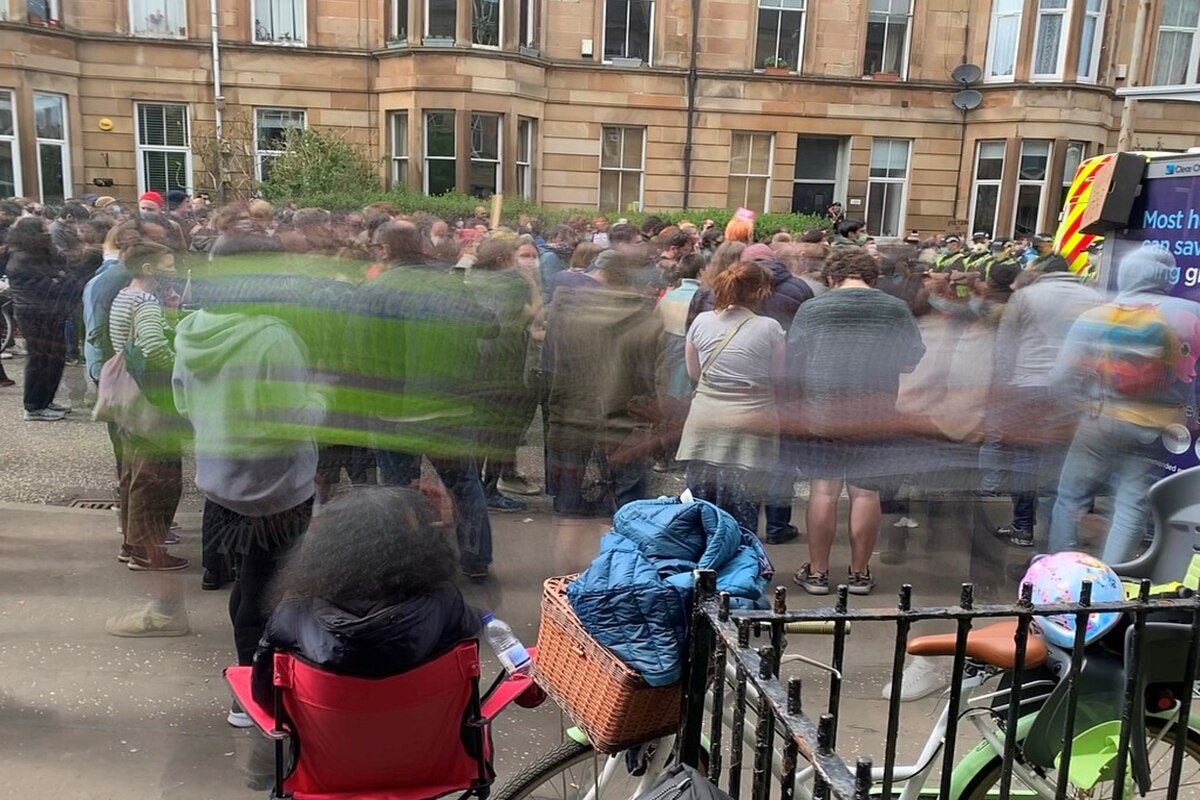
When the Glasgow Film Festival opens in 2026 with Everyone to Kenmure Street, it offers opportunity to open a national conversation about protest, belonging and who we believe ourselves to be. The film tells the story of a spontaneous civil resistance in Glasgow, when hundreds of residents surrounded Home Office vans during a dawn raid and prevented the detention and deportation of two men accused of immigration violations.
Yet that image of solidarity sits in stark contrast to other scenes witnessed in Scotland – large groups protesting outside hotels housing people seeking asylum, including in Falkirk. In many of these cases, local communities say they were given no indication that the Home Office would be housing significant numbers of asylum seekers nearby, nor any voice in how such changes might affect local services and cohesion.
So which protest tells the truer story of Scotland? The crowd blocking the vans in Kenmure Street – or the crowd gathered outside a hotel? The uncomfortable answer is both.
Culture is complex – and so are we
As soon as we describe any group in simplistic or definitive terms – whether migrants, accountants or Scots – we are missing something. Culture is layered, contradictory and constantly evolving.
The word ‘culture’ is small and often used casually – ‘the culture around here is…’ – yet it is packed with complexity. Perhaps that is why organisations, communities and even nations shy away from examining it too closely. To look at culture closely, is to open a can of worms. There is contradiction. There is ambiguity. There are competing values and competing fears.
Cultural intelligence
I frequently work with organisations experiencing dysfunction. Cultural misunderstandings arise between departments pulling in different directions – sales and quality assurance, for example – just as they arise between people shaped by different societal norms. The skills required to bridge those divides are learnable, but they demand intention.
Cultural intelligence is about navigating that complexity rather than denying it. This is not naïve optimism. It is practical work. Cultural intelligence is not about being ‘nice’; it is about developing the capability to collaborate, influence and lead across difference. The aim is not abstract theory, but action. In complex and divisive times, that focus offers clarity and hope.
Heart room and house room
An experience which shaped my outlook was visiting my great aunt Ruth. She lived in a small but ‘n’ ben near Oban. My parents, four siblings, myself and a dog squeezed into that wee two-roomed house with a lean-to kitchen each May holiday when I was a child. What I remember is not overcrowding, but freedom, joy and love. Aunt Ruth’s maxim was simple: “Where there is heart room there is house room.”
It is a phrase that lingers when considering Scotland’s current tensions. I find myself pondering what happens to a people who have run out of heart?
Finding your comfort with discomfort
Keeping your heart open means acknowledging something many find difficult: people protesting on both sides often care deeply. They may have very different experiences and perspectives, but most would say they are motivated by hopes of security, stability and a positive future for their families.
For the first half of my life, the UK lived with civil conflict. Those who grew up amid the division and violence in Northern Ireland frequently say they could not have imagined change towards peace. Yet change came when people started to have conversations across deep divides. Complex, messy and ongoing.
Protest, peace and the possibility of growth
I’m proud of the protest on Kenmure Street. A neighbourhood showed solidarity with two men who had lived there peacefully for a decade. That image of collective action projected compassion and courage.
Equally clear is my discomfort with protests targeted at vulnerable people in the places they are temporarily housed. But disagreement does not negate the right to peaceful protest. Nor does it remove the need to listen.
If cultural intelligence teaches us anything, it is that shutting down conversation rarely produces good outcomes. The protests outside hotels require space for listening and discussion – not to legitimise hostility, but to understand concerns and to co-create solutions that promote peace, security and respect in a world facing turmoil and uncertainty.
Love and respect are key
As Scotland watches Everyone to Kenmure Street on the big screen, we are invited to consider what kind of culture we want to nurture. A culture defined by fear and caricature, or one capable of holding tension without losing its heart?
In all things, I try and hold onto my father’s maxim: “look out with love and respect”. It is not a sentimental instruction. It is a discipline. And perhaps it is the discipline Scotland needs if it is to reconcile the two images of protest that now sit side by side.
If we are willing to develop our cultural intelligence, individually and collectively, then the story we tell about Scotland need not be either/or. It can be a story of growth.
More on society:

CLICK HERE TO DONATE TO OUR CROWDFUNDER
HELP US BECOME STRONGER SO THAT WE CAN CONTINUE TO DELIVER POWERFUL CITIZEN JOURNALISM!







