I’m certain that I’m not the only one who, as a child, thought of the year 2000 as something distant. I used to think that by then, I would be over 30 years old and therefore an old woman. Now, well beyond my thirties and about to count the first quarter of the 21st century, I realise that by 2075 I’m unlikely to be alive. If I am, it will have to be attributed to a disgraceful scientific advance beyond my control.
Memory turns on our dependence from the past and the future, and we have made the pass of time a quantifiable value. Memories with numbered years attached to them are then stacked up and we see them playing about in our minds, often adding, subtracting, juxtaposing and replacing each other. Don’t feel shocked if you haven’t realised that we will reach 2050 in only 25 years from now.
Simple idea 1: animal years vs numbered years
So what if instead of numbers, we counted the passing of time in animals? The Chinese Calendar will soon begin the Year of the Snake, and we could follow a similar idea where instead of a sequence of 12 animals, we assign each year to an exclusive animal because we do not repeat years on this planet: each year is unique and memorable for one reason or another.
Imagine the passing of time in animals: the year of the badger, the year of the white rhino, the year of the magpie, the year of the shark… we still have enough animal species on Earth to count about 7.8 million animal years to come.
We could even add dinosaur years for each known dinosaur to remember that there might be a time when everything (including us) may disappear. On that note, we could already count 881 animal years in known species of animals that have become extinct since the year 1500. A sobering way to remember that as humans we have demonstrated an appalling ability to destroy the planet and every living thing sharing it with us.
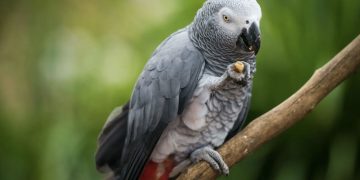
2025: the year of the yellow-eared parrot
‘Naming 2025 “the year of the yellow-eared parrot” could be the year when we stop those repeating claims and promises like parrots.’
Naming each year to honour an animal, or the sad potential extinction of an animal like the yellow-eared parrot, could make more apparent the finite nature of our existence, and that of other species we share the planet with.
We are not infinite like numbers, and neither are the resources of the planet. Species are particularly finite now that we are disappearing them at an alarming speed; Harvard biologist E.O. Wilson estimated that 30,000 species are being driven to extinction every year.
If we chose the animal for the year ahead just a few minutes before midnight on New Year’s Eve, we could have the chance to focus on the present, removing the value we give to the long-term goals and promises from governments, often irrelevant by the time the deadline arrives.
Take for instance The Paris Agreement (2015), which saw 193 countries committing to reduce greenhouse gas emissions, aiming to keep global warming temperatures below 2°C. The long-term goal is neutrality or net zero emissions by 2050. Meanwhile, 2024 is already recorded as the warmest year on record. It’s another pledge that promises to dissolve by 2050. When we think in abstract numbers, years seem far away.
Simple idea 2: fines for misuse of language, particularly for repeating the word “sustainable” like parrots
If we got a penny every time someone used the word “sustainable” to wrongly imply that something is environmentally friendly or that it offsets carbon emissions, we could probably have created by now a very wealthy sustainable fund (pardon the pun) to support those struggling in their true effort to save the planet from the disasters caused by human activity.
Sadly, sustainability claims in every industry are often nothing but greenwashing. Naming 2025 “the year of the yellow-eared parrot” could be the year when we stop those repeating claims like parrots. I am sure the few yellow-eared parrots left in Ecuador and Colombia will find this a sensible and appropriate measure.
Something sustainable, according to the Cambridge dictionary means “something able to continue over a period of time.” That’s it. In the context of environmental impact, it has become understood as “something that causes little or no damage to the environment”, which is difficult to conciliate when supermarkets continue splurging in new plastic packaging. In spite of some efforts, reuse and refill schemes seemed to have failed after only achieving a 7% plastic packaging reduction.
Recycling is not a synonym for sustainable either. Reusing a plastic bag does not mean that the bag was not produced in the first place. The truth is that the “100% recyclable” label does not take into consideration that recycling plastic demands a complex infrastructure and may consume more energy and increase the carbon footprint if it can only be recyclable outside of the UK.
More in environment.
Like the article? Why not share it on Bluesky?

CLICK HERE TO DONATE TO OUR CROWDFUNDER
HELP US BECOME STRONGER SO THAT WE CAN CONTINUE TO DELIVER POWERFUL CITIZEN JOURNALISM!