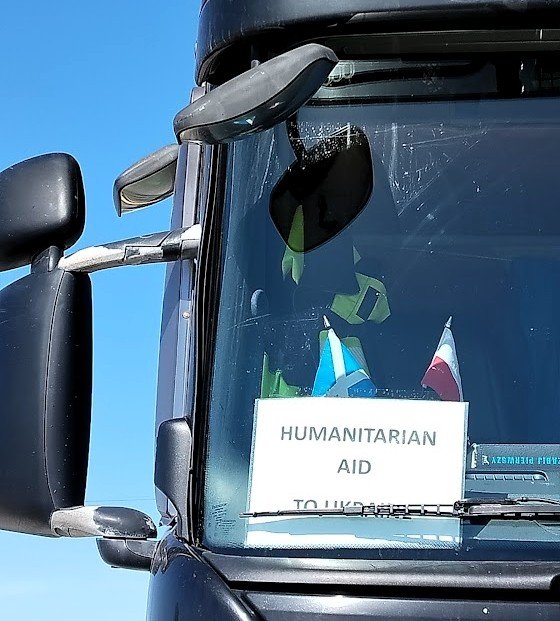
I am driving down the road after delivering a truckload of humanitarian help. Almost a complete hospital: beds, furniture, air conditioners, physiotherapy equipment, doctor’s gowns – as well as fire extinguishers and firefighter’s protective clothing. All this has been donated by Finland and it will now serve as a hospital for veterans of the Ukrainian Armed Forces who lost their health in the fight for freedom.
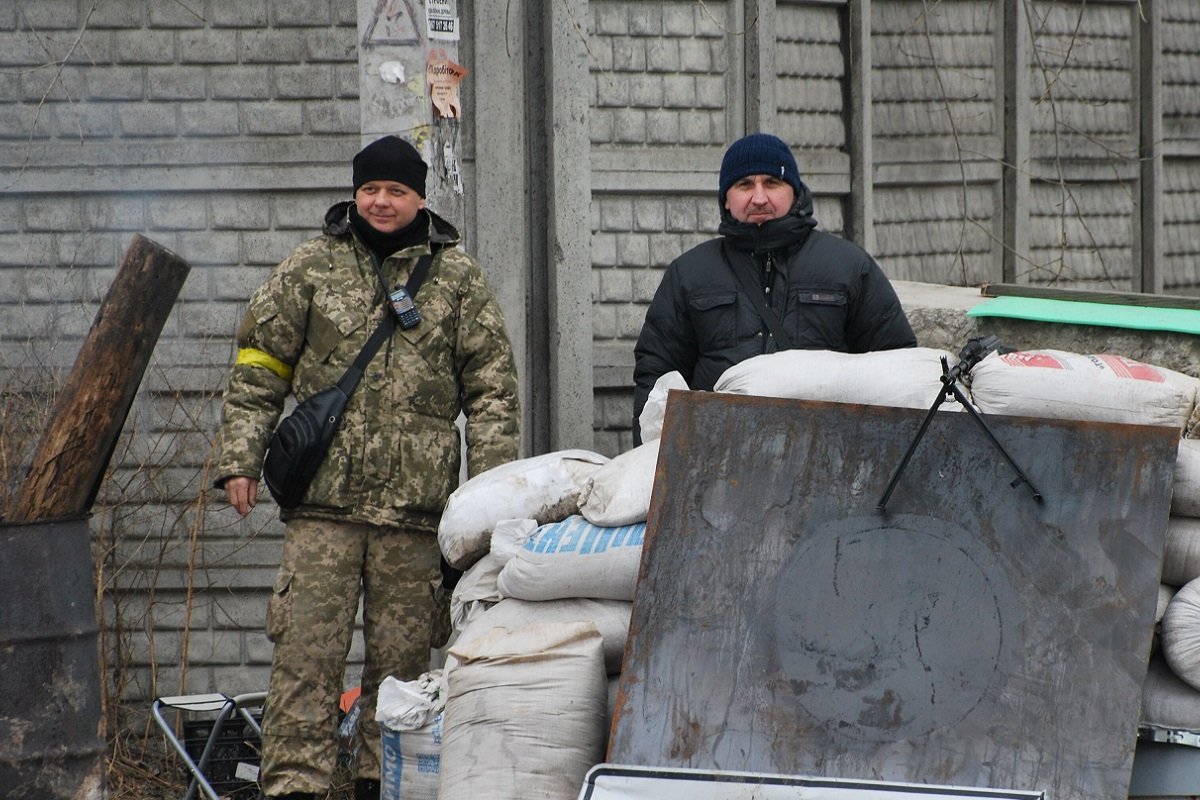
It’s a warm, sunny day in April, and the trees are already covered with that spring neon green. I drive slowly, as the road is in really bad condition. The carriageway narrows, as signs on the edge of the tarmac warn about the mines. Some military installations can be seen in the distance, and on the road itself there is a heavily fortified military block post. The soldiers, who could hear me a mile away, get out of their shelter. The empty trailer rattles terribly as I slowly make my way over the sea of potholes. I stop with the hiss of the pneumatic break and kill my engine. I don’t speak Ukrainian, but the youngest of the soldiers speaks English, so we can communicate.
They meticulously check all the paperwork proving that I just delivered a load of humanitarian aid. They ask to see my truck and trailer registration document – the Finnish language paperwork really confuses them, so the older soldiers strategically retreat back to their shelter, leaving just me and the young soldier on the road. I am asked to open the back of the trailer.
Paperwork and permits
The soldier looks into my cab too and asks to see the insides of the side lockers in the truck. All seems good, but to drive on that particular road I should have had a special permit. I arrived in the town from the other side last night, but the road was in truly tragic condition and I was barely able to make it with my vehicle, which is designed to traverse miles and miles of perfectly smooth motorways at 85km/h. The locals told me I should take this road – but, as locals, they all have their special permits, and I don’t. With my permission, they take a picture of my documents and send them by phone to their command centre to see if I might be allowed to cross.
“It might take five to 15 minutes”, the young soldier tells me. I am not worried. If anything I am pretty relaxed. I have no reason to be afraid of the defenders of Ukraine – if anything their presence makes me feel safer. And from my experience so far, people in Ukraine could not be more helpful and welcoming – they seem to be truly grateful for all the humanitarian help they are getting from their friends abroad. Sometimes I even feel embarrassed with all the attention I am getting and all the gestures of gratitude I simply don’t deserve, as I am not a hero –merely a driver.
Small talk amidst sandbags
The soldier is not tense either. He just looks tired. We pass the time with small chit chat, talking about my truck, where I come from, the fact that I lived in Scotland and now I live in Finland, what the weather is like in Helsinki now, and so on. At one point, I ask something about the power plant visible in the distance. It becomes very clear that this is something we should not be talking about. He knows very well that I know what electric plant it is, but rules are rules. There is a moment of awkward silence.
I tap my fingers on the steering wheel. He slowly looks around. He glances at the big pothole next to my truck; at the rusty anti-tank metal spider-thingies; at the barriers made of crumbling concrete; at their shelter protected with layers and layers of sandbags, out of which some weeds have already started to grow. He adjusts the gun that is slung from his arm. The silence is broken by the squeaking suspension of an old Lada that’s just arrived from the other side and is now crossing the huge pothole. I can’t read Ukrainian, but as far as I can guess, the sticker on the car says something along the lines of “I ❤️Mariupol”. We both watch the car drive away – I observe it in my truck’s mirror, and he turns around to follow it with his eyes, turning his back to me. The car slaloms through the concrete barriers and speeds up, leaving a cloud of dust behind. The silence returns.
Life before the war
“I used to be a manager, you know? Before the war, that is”, he says suddenly. I don’t know what to say; I am aware that this is not really addressed to me. At this moment, his phone chimes. I got the all clear: I am free to go. We wave at each other; I start my engine and slowly roll through the pothole-filled gap between the concrete barriers. There is a junction ahead that will take me back on the main road towards the Polish border. I can see him in my mirror, looking at the back of my vehicle, even though a battered Zil tipper truck is already entering the checkpoint from the other side.

Bylines Network Gazette is out!
The latest Bylines Network Gazette is out now. Become a Friend of Bylines Network or upgrade to a paid Substack subscription, and you will get access to a vital collection of citizen articles and stories.
Journalism by the people, for the people.