



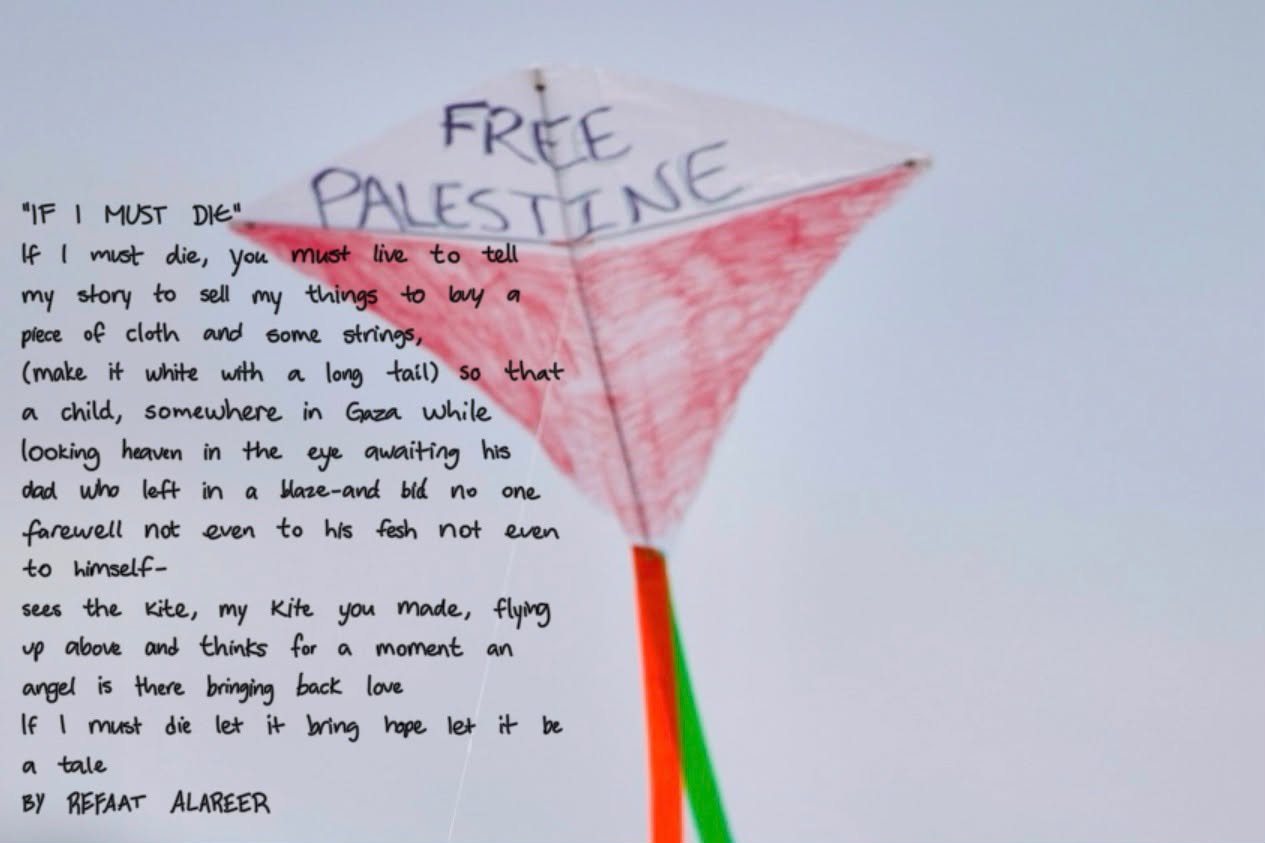
This is the disturbing logic behind the recent Israeli threats over kites and balloons being flown from Gaza. Israeli Defence Minister Israel Katz has said a balloon should be treated as a kite, and a kite, whether it carries explosives or not, should be treated as a drone.
A kite is not a drone
Israeli officials have threatened further military action and evacuation orders involving areas in Gaza that fly kites. One of the few things children can still make for themselves is now seen as a weapon because, in Gaza, a kite is not a toy. However absurd this seems, the seriousness of the situation should not be ignored.
Kites represent childhood for the children of Gaza. They evoke memories of a more ordinary life: long summer days, the beach, open skies and the simple pleasure of watching their creation rise into those skies.
Distinction matters. A weapon is designed to cause harm. A child’s kite is designed to cause joy. What can remain of childhood when everything in a child’s life is interpreted by the logic of war? For parents, this warning leads to another decision: could allowing their child to fly a kite expose them to danger?
Imagine how this shapes a child’s understanding of the world. Imagine telling a child that an object they designed with their own hands could cause harm to themselves or others. Finally, imagine telling your child that even joy can have consequences.
Gaza’s children have already been denied their toys. They have spent three years living under restrictions that have made ordinary toys and recreational materials difficult to access. When children cannot access to toys, they improvise. They turn scraps and discarded materials into games. They attempt to make something good out of the bad that surrounds them. A few sticks, paper and string can become a treasured afternoon of their childhood.
Humanitarian organisations have repeatedly stressed that play is not a luxury but an essential part of children’s psychological well-being and development. In January, UNICEF announced recreational resources were allowed to enter Gaza after two years of restrictions. The first shipment included 5,168 resources intended to support more than 375,000 children. For such a basic matter to become international news represents the scale of deprivation Gaza’s children are suffering from. After this announcement, children are told that even toys they create themselves will be treated as threats. What else are they supposed to do? How can they play?
There is such a tendency to treat children’s needs as secondary during genocide. Food, water, medicine, and shelter rightly come first. But children also need to play.
Children should be laughing without being interrupted by an explosion. They should be able to draw pictures that don’t feature tanks and funerals. They should be able to run without being told where it is safe to stand. They need to see a future beyond survival.
The destruction of schools and playgrounds, repeated displacement, the loss of family members has stolen these children’s childhoods. The prolonged fear and suffering endured has forced them to grow up far too quickly. They have learned the vocabulary of war before they have peace.
These children know the sound of attacks and violence of war, but they still cling to something of childhood; they make kites. If Israel states security means children cannot fly a kite, then parents cannot allow their children to play outside. They cannot allow them to play safely anymore. This security measure leaves no room for childhood. Ordinary objects are becoming potential military targets. Palestinians are being denied normality; children’s freedom to play.
The politics of killing joy
Wars do not only destroy bodies and buildings. It destroys routines and memory. The the ability to experience joy without guilt or fear. War destroys the expectation that tomorrow will be ordinary, After years of bombardment, displacement, siege and destruction, what does security really mean to a child who has never been allowed to feel secure?
There is something the language of war cannot fully erase: a child’s instinct to play.
A kite matters. Though a kite is a small, fragile and almost weightless object, it carries something that this genocide has struggled to destroy – the hope that life can eventually be more than just survival.
Gaza poet and professor Refaat Alareer captured the power of the kite in his poem If I Must Die. The poem tells the story of a child watching a kite rise into the sky, carrying the message of love and hope. Although, Alareer was killed in Gaza during December 2023, the important image remains through his words. In Alareer’s poem, the kite becomes an angel; for children today, it risks becoming a target.
Today, Gaza’s children still make kites. Although children are still learning that even the open sky has rules, borders and threats. A kite is not a weapon, a child’s joy is not a security threat. If the simple act of looking up has become frightening to these children, perhaps the question is no longer what the child is carrying — but what the sky has come to represent.
But maybe that is precisely why children continue flying them. Every kite rising above Gaza is a refusal to let genocide have the final word over childhood. Israel may call the kite a weapon, but Gaza’s children know what it really is: a toy, a memory, a treasured piece of their childhood.
The kite still rises because the children believe there should be something above them other than war.




